




ASUS may ship some budget and mid-range Windows 11 PCs with 8GB of RAM instead of 16GB as memory costs rise. The company mentions it can only pass on so much of the extra costs, with some potential buyers already putting off their PC purchases as PC prices rise.
On the company’s November 12 earnings call, an analyst from JP Morgan asked if ASUS could still pass higher component costs on to buyers if PC shipments fall 10% to 15% next year. Co-CEO S.Y. Hsu said ASUS used to put 16GB of RAM in some lower-priced PCs to give buyers a better experience, but Microsoft’s changes to Windows mean that “even 8 GB is able to yield an acceptable experience.”
Hsu further said the company had already bought memory ahead of time in the second half of 2025 to manage costs. However, the prices were gradually raised as the stock was used up.
Why ASUS may cut RAM from 16GB to 8GB on some Windows 11 PCs
Hsu pointed to ASUS’s high-end RTX Spark PCs to illustrate how differently potential buyers respond to price increases. He said even configurations with 128GB of memory were selling well at higher prices. However, for budget and mid-range PCs, the story is quite different. He further said buyers in this situation would be much less willing to pay the full increase in memory costs.
Hsu said that ASUS used to put 16GB RAM in some of those cheaper machines to give buyers a better experience. Shifting some PCs to 8GB would give the company another way to respond to rising memory costs we have seen lately. The co-CEO left the specific models, prices, and timing open. As far as it goes, we don’t know how much an 8GB version will cost. Given this uncertainty, I’d love to see a meaningful saving before giving up half the RAM.
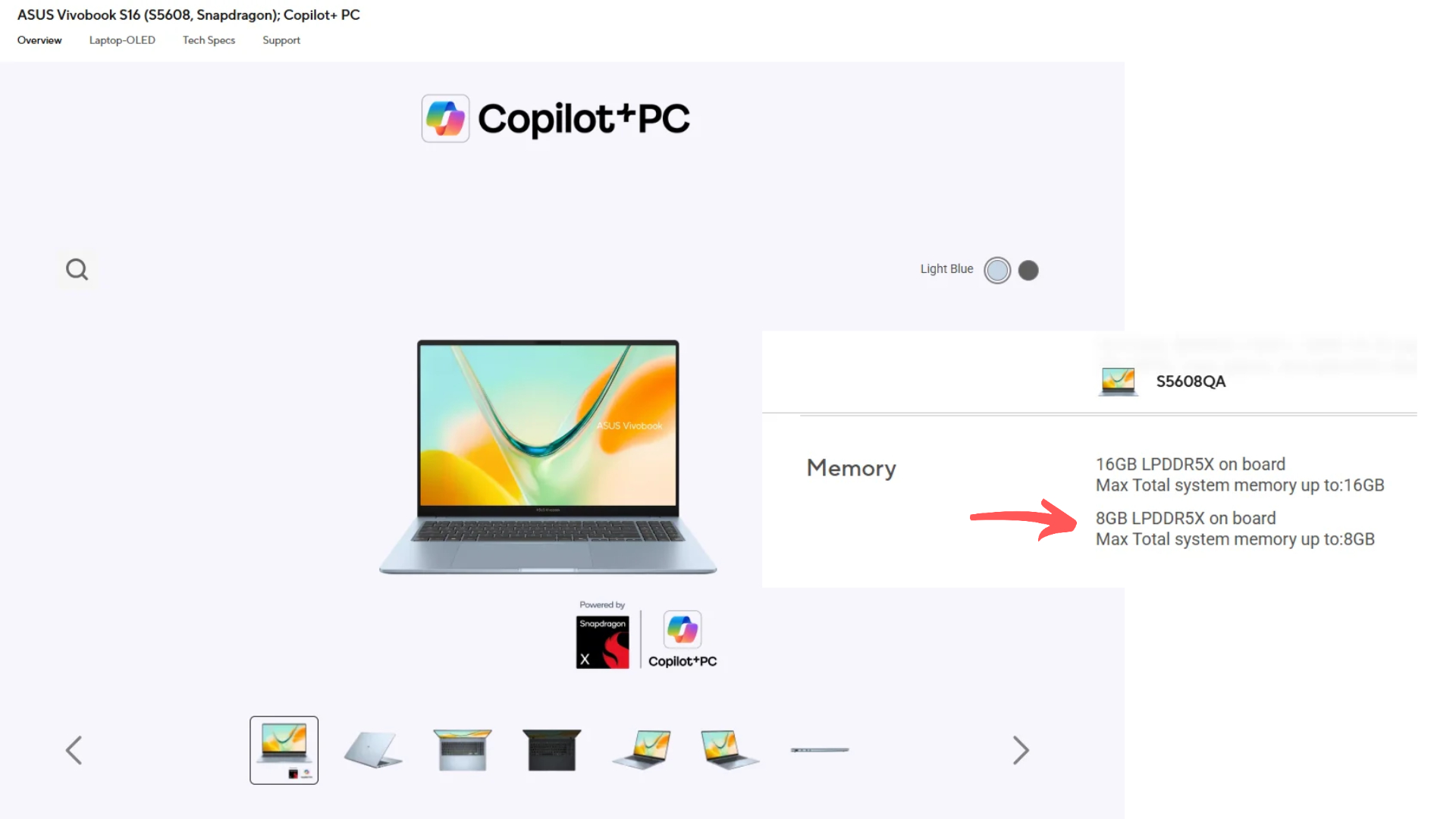
ASUS is considering the move as it prepares for a tough year for PC sales. In the earnings call, Hsu also mentioned they expect the overall PC market to shrink by 10% to 15% in the upcoming year. “Breaking the following year into two halves, we expect that the first half will have a shrink, while the second half may experience a rejuvenation.”
The Taiwanese PC manufacturer thinks 8GB can be enough for some PCs, and, well, it’s giving Microsoft some of the credit. “We have worked with Microsoft on this one,” Hsu said. He said changes to Windows have made 8GB workable. However, he didn’t get into what the two companies worked on together.
How Microsoft made Windows 11 run better on 8GB PCs
At some point or another, we’ve all gone through the same struggle. Leave a few apps and a browser open on an 8GB laptop, and you’ll most likely come back to a tab that has to reload. When Windows needs room in its RAM, it can move some data to your drive, where it takes longer to get back. Microsoft, in its November 3 blog, compares the drive to a drawer that stores extra app info.
However, Microsoft has now changed how Windows compresses memory and decides when to move that data to the drive. The Redmond giant says Windows 11 can now keep up to 2GB more of active data in memory on PCs with 8GB of RAM.
Well, twenty Edge tabs and sometimes even a single 4K video can already stress an 8GB laptop badly. In its own test, Microsoft added large Office files, Outlook, and even File Explorer to this mix and kept everything open. The same test was run on an HP OmniBook 3 using two different Windows 11 builds. The company mentioned that the workflow completed up to 40% faster than with the January 2026 builds.
Windows 11 26H2 uses less RAM on 8GB PCs in our tests
In our own earlier experiment, an 8GB laptop used 3.3GB of RAM after a restart on Windows 11 26H2. That’s compared to 5GB on 25H2. So I wondered: how would the 8GB and 16GB versions of the same ASUS machine feel side by side?
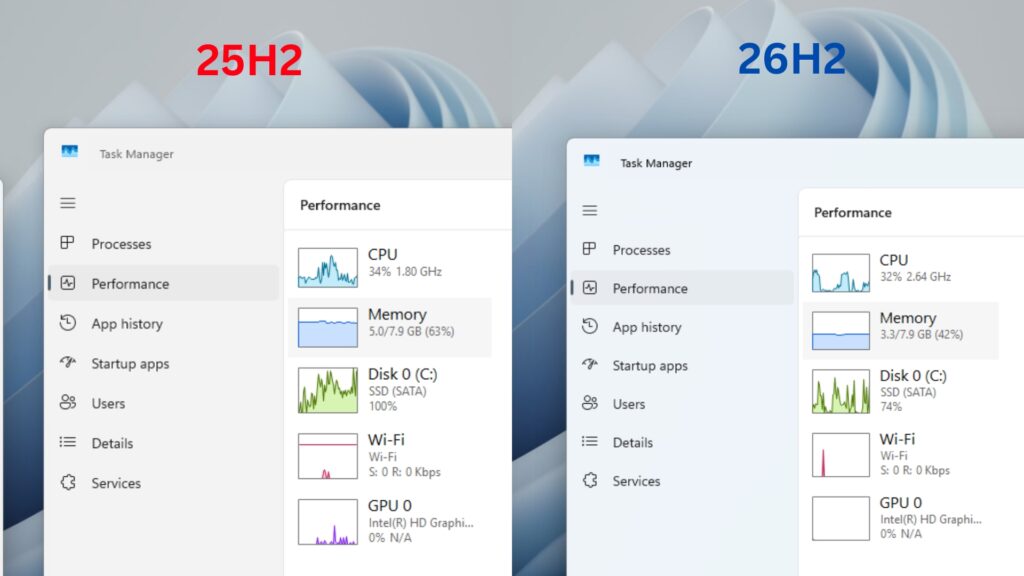
Well, in our own Windows 11 VM test, we tried 8GB and 16GB configs on the same virtual machine and checked how much RAM Windows used after a restart.
Interestingly, a test commissioned by Microsoft found that a 2026 Dell XPS 13 with 8GB of RAM kept up with a 16GB model from 2021 in web browsing and 4K video exports. However, there are five years of processor, memory and storage upgrades between those two laptops.
Would I buy a laptop with 8GB of RAM in 2026?
The one factor that would make me consider an 8GB Windows laptop in 2026 would be if I can add more RAM later. As a potential customer, I would check the config page and see what the model supports. If the RAM is locked at 8GB, what’s the big saving that makes me accept it?
An 8GB laptop is fine for browsing and opening documents. But if the price gap ends up being small, it makes much more sense to get 16GB. Even with the gains Microsoft saw in its test, it’s very easy to turn two browser tabs into 20 when you’re multitasking. So, Windows 11 update or not, I’ll be looking for that extra room from day one and not risk an “acceptable experience.”