



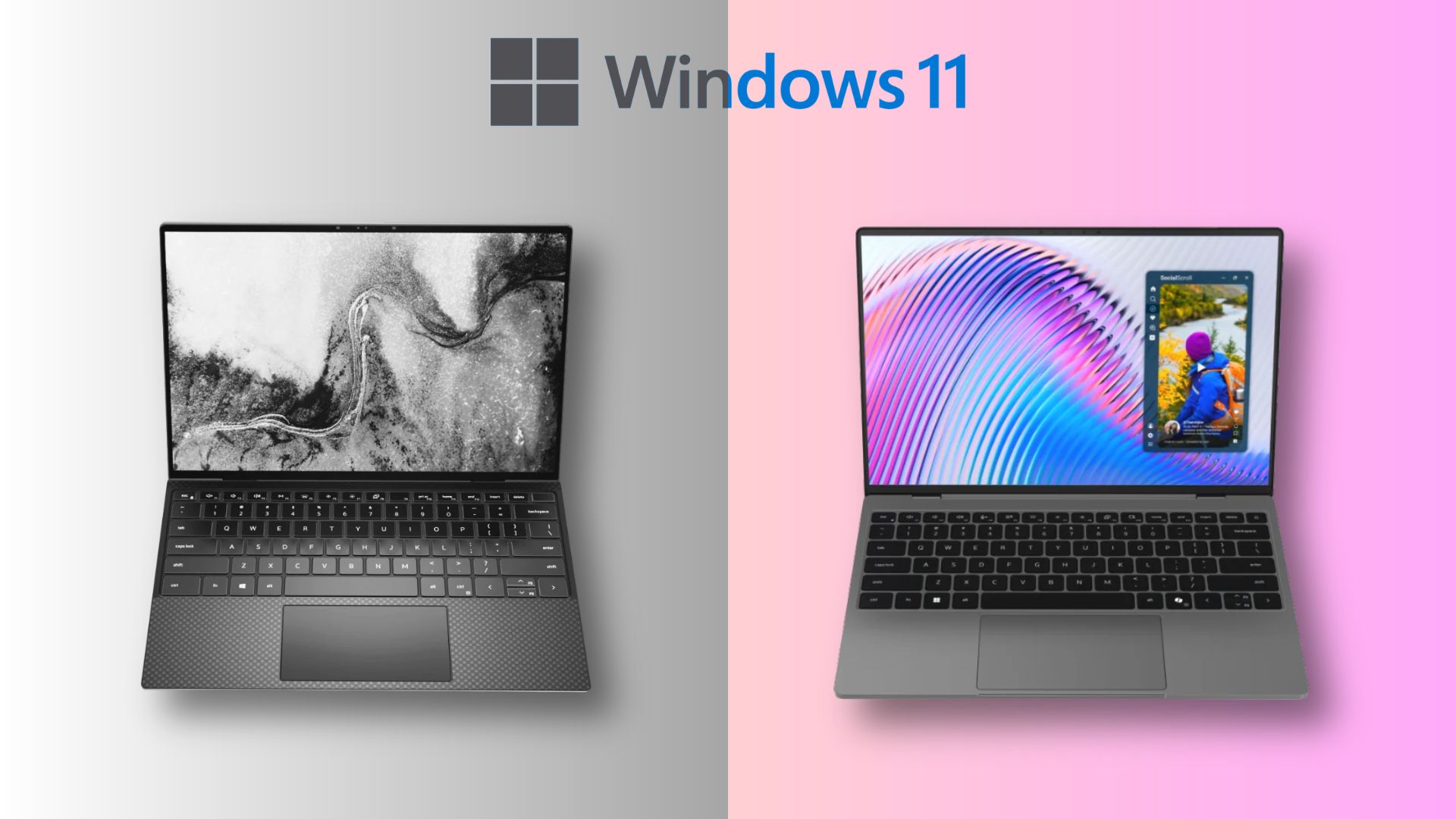
Microsoft says a 2026 Windows 11 laptop with 8GB of RAM performs about as well as a 16GB model from 2021 in several everyday and demanding workloads. The claim is about “Raising the ceiling with new silicon” and is from third-party testing that the company commissioned, but it comes combined with a year of work to make Windows 11 use less memory.
In case you forgot, Windows 11 launched in October 2021, 5 years ago, so Microsoft is pitting today’s 8GB laptops against the 16GB PCs people bought when the OS launched. This is all intensely exciting; however, I can’t help but be amused at how the company is saying so after spending the last couple of years telling everyone to buy 16GB.
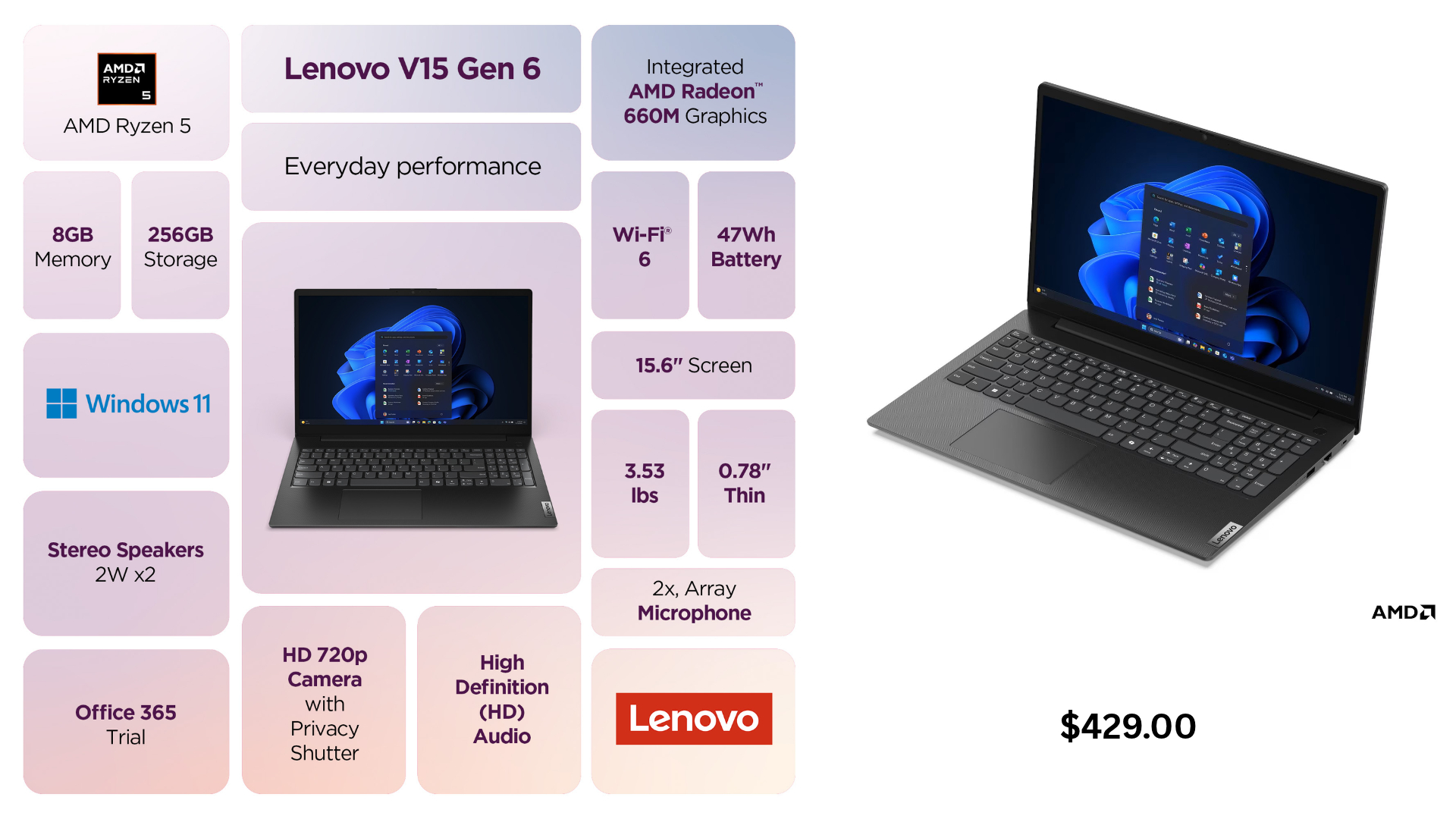
Microsoft says a new 8GB laptop can keep up with a 16GB PC from 2021
In their November 3 blog post, Microsoft says the 2026 8GB laptop performed about as well as the 2021 16GB configuration across CPU performance, web browsing, AI tasks such as background blur and face detection, and 4K video export.
The company also says the new 8GB Dell XPS 13 delivered up to 94% faster multi-core CPU performance than a 2021 model with 8GB. Note that the 94% compares two 8GB laptops from different generations, so it comes from the newer processor, faster memory, and storage. Windows 11 didn’t get 94% faster!
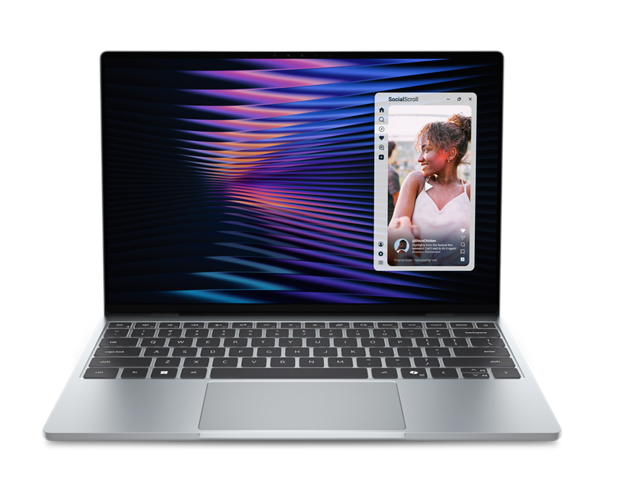
The blog’s footnotes say the results come from the devices tested and aren’t representative of all 8GB PCs. It also admits that you will need a PC with 16 GB or 32 GB when the workload gets heavy.
“Memory still matters for heavier and highly multitasked workloads, but the results from this Dell PC show why the complete PC, not memory capacity alone, shapes the experience.”
The commissioned report tested different 2026 Windows 11 laptops with five-year-old Windows PCs that have similar specs (emphasis on similar), across different categories, including budget laptops and gaming machines. The report found that:
- Newer Windows 11 PCs deliver up to 2x faster multi-core CPU performance than five-year-old PCs with similar specs.
- Web browsing battery life is up to 2.4x longer, and the longest-lasting laptops reach up to 15 hours.
- Everyday productivity laptops are up to 45% faster in Office apps.
- Gaming laptops get up to 65% higher frame rates in Forza Horizon 5.
To be clear, these gains come mostly from newer, more efficient processors and faster memory, even though Microsoft puts them right next to how they optimized Windows 11. It’s not the first time, either. Last year, Microsoft said Windows 11 PCs were up to 2.3x faster than Windows 10 PCs, but that test compared Windows 10 PCs running 6th to 10th Gen Intel chips with Windows 11 PCs on 12th and 13th Gen ones.
You can also argue that the company is saying this to make you feel okay purchasing an 8GB Windows 11 PC in 2026, for the same price as a 16GB one from yesteryear. However, credit where it’s due, Redmond did manage to do a ton of optimization work to bring down the OS RAM usage.
Windows 11 is using less RAM, and Microsoft explains how they did it
Of course, a newer chip is only half of the equation. Windows boss Pavan Davuluri also explained what Microsoft changed in Windows 11.
Windows has compressed memory for years, but on 8GB PCs, Microsoft has now tuned how much it compresses and when it moves data to slower storage. Windows can now keep up to 2GB more active data in RAM, so that Edge tab you left open is less likely to reload. As Davuluri said, “the real test is whether your PC stays responsive,” which is also why high RAM usage in Task Manager isn’t a bad sign as we think it is.
Microsoft also trimmed the weight from some parts of Windows and their apps on 8GB PCs.
- Widgets loads only when opened, saving about 200MB.
- Edge puts inactive tabs to sleep after 15 minutes, down from two hours, and can open up to 33% faster.
- Teams turns on Efficiency Mode by default and launches up to 20% faster.
- Committed memory growth during multitasking dropped by up to 900MB across Windows, Edge, and Microsoft 365.
In Microsoft’s video, an 8GB PC on the January 2026 update kept stalling on blank windows while the 26H2 PC moved on to the next app. In our testing on an 8GB laptop, RAM usage after a restart dropped from 5GB to 3.3GB after moving to 26H2.
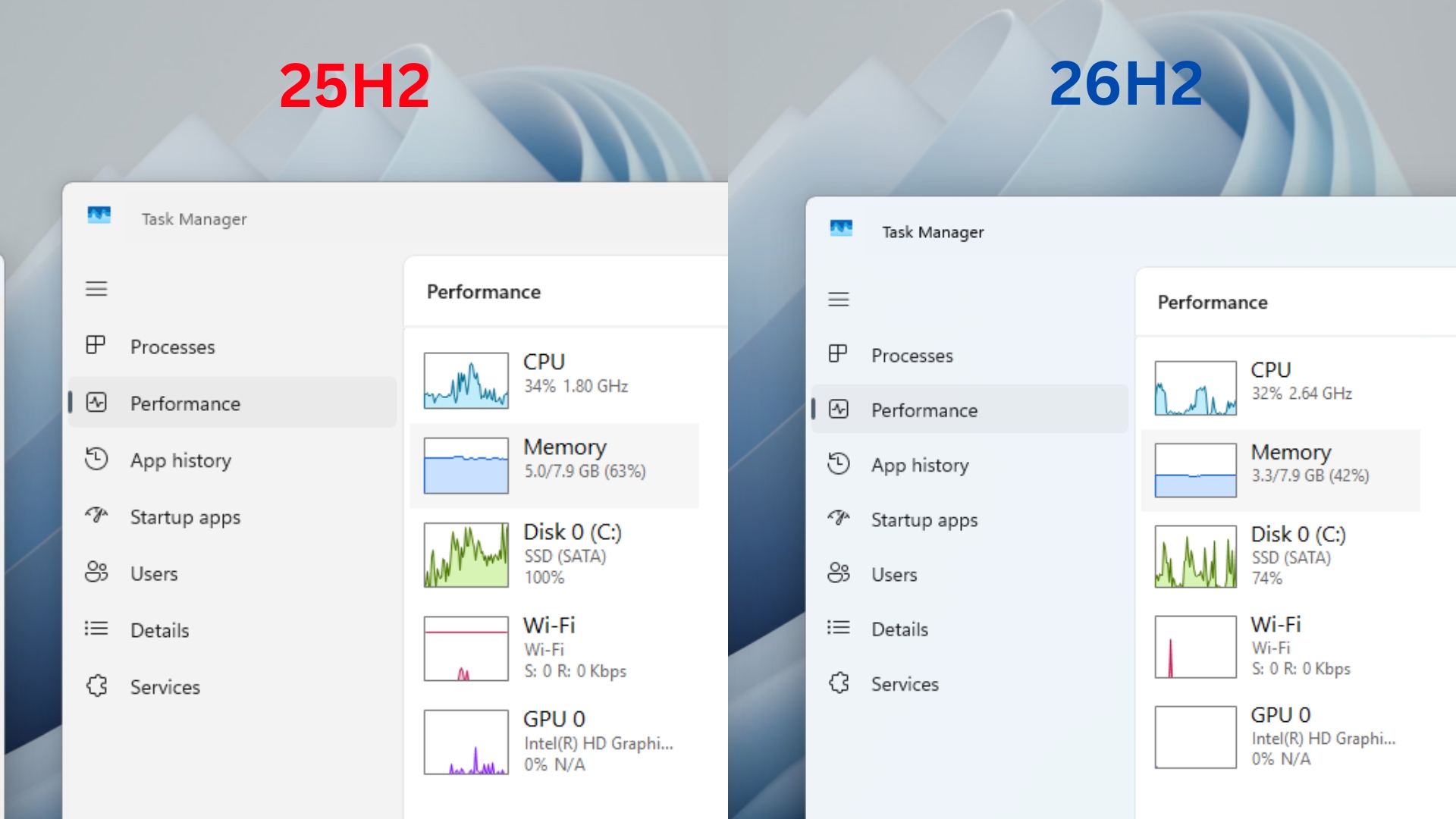
I also got similar results on a clean install of Windows 11 25H2 and 26H2. This was a test that Windows Latest did before Microsoft’s blog was published, but we used the same build as Microsoft for their testing. Truth be told, I was genuinely surprised by the reduced RAM usage, and I wondered how much optimization work was done.
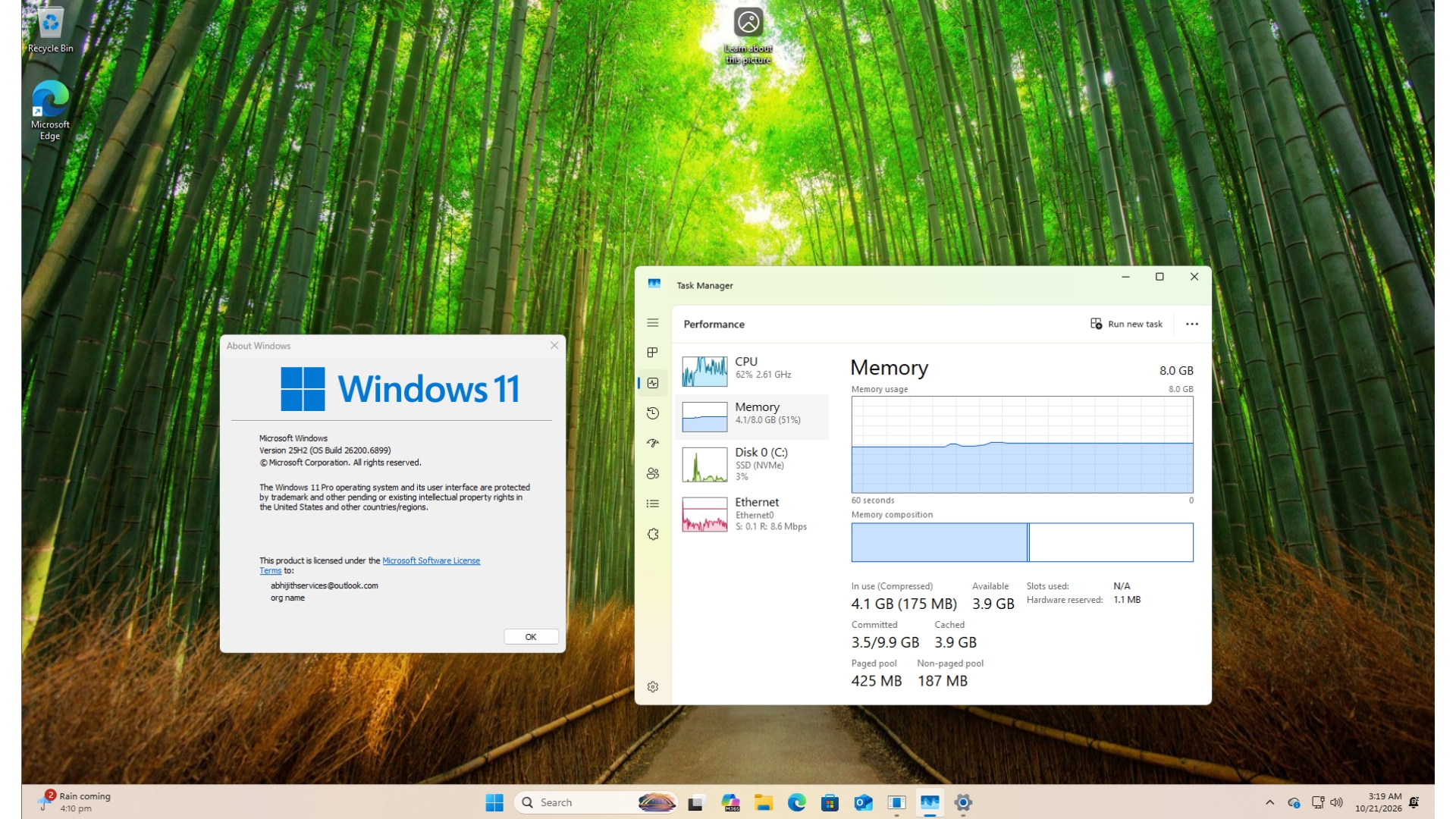
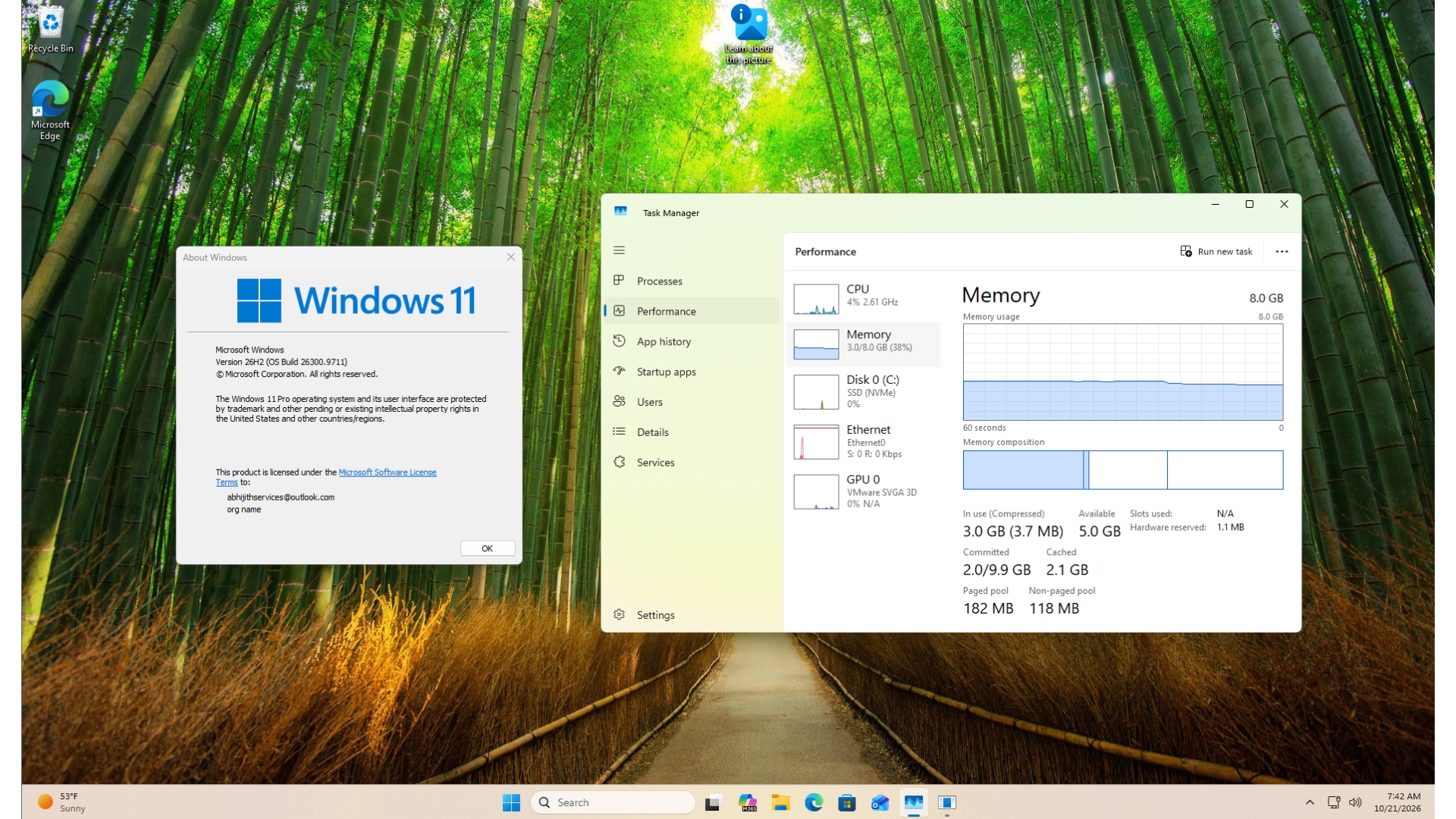
However, the bigger work is still in progress. Microsoft says WinUI 3 apps like File Explorer, Notepad and Paint are being designed to open faster and use less memory. Search and Widgets will share one web engine, OneDrive and Photos another, and Microsoft is working with PC makers to reserve less RAM for hardware. This is why I’m excited for Windows 11 27H2, next year.
Windows used to need very little RAM, and now 8GB is important again
With every generation, RAM got cheaper, and the industry kept adding more of it. A feature that needed a few hundred extra megabytes wasn’t a problem when people bought 16GB and 32GB laptops they didn’t need.
| Windows version | Year | Minimum RAM |
|---|---|---|
| Windows XP | 2001 | 64MB |
| Windows 7 | 2009 | 1GB (32-bit), 2GB (64-bit) |
| Windows 10 | 2015 | 1GB (32-bit), 2GB (64-bit) |
| Windows 11 | 2021 | 4GB |
| Copilot+ PCs | 2024 | 16GB |
These are minimum requirements, not what you’d want for a smooth experience (Microsoft recommended 128MB for Windows XP, for example, which sounds funny, but it’s double the minimum!). Even so, Windows 11 doubled the 64-bit Windows 10 minimum, and Copilot+ PCs quadrupled it.
I believe that the breakthrough was when the MacBook Neo happened. Apple’s $599 laptop that runs on the A18 Pro, an iPhone chip, with 8GB of RAM, made people realize how compromised Windows 11 felt with 8GB. IDC said the Neo is pushing the PC industry toward “a more efficient OS from Microsoft,” and here we are now.
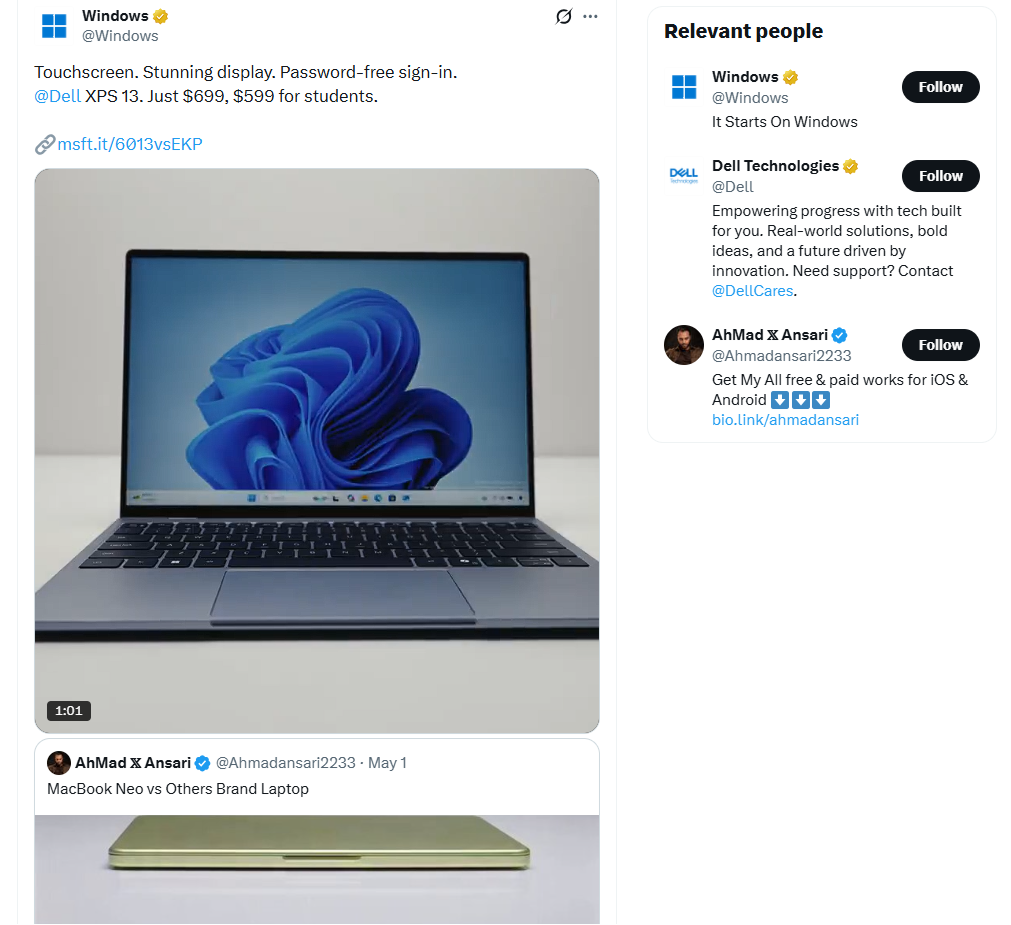
Meanwhile, AI data centers are eating up memory supply, and RAM prices keep climbing. PC makers are bringing 8GB laptops back, and the 13-inch Surface Laptop, which launched with 16GB and a Snapdragon X Plus at $899, now has an 8GB base model at $949.99. Yes, you now pay more for half the memory.
Ironically, the best thing to happen to 16GB and 32GB PCs might be the 8GB crunch. Every megabyte Microsoft saves on an 8GB laptop is saved on yours too.
If Microsoft could optimize Windows 11 this much in one year, I’m sure there’s a lot more left to squeeze out. Personally, I think it’s a wise call to keep fixing Windows 11 before talking about Windows 12. People should love Windows 11 enough to want its successor, and an OS that runs well on a cheap 8GB laptop is a good place to start.