







Apple’s $599 MacBook Neo turned out to be the catalyst Microsoft needed to fix Windows 11, after years of gamers, IT admins, and everyday users complaining that the OS felt slower and heavier.
For two years, Microsoft and its OEM partners treated Windows 11 mostly as a stage for pushing Copilot and other bloatware, while the OS got neglected. Backlash, despite being loud and clear, didn’t move the needle.

However, as PC sales started to decline and people swooned over Apple’s colorful budget MacBook, Microsoft’s OEM partners panicked over their already razor-thin margins getting even thinner, so much so that the ASUS CFO had to reassure investors, saying that Microsoft and partners were working on keeping the PC Industry alive:
“I believe our PC vendors, including upstream vendors like Microsoft, Intel, and AMD, they’re all taking this very seriously, discussing how to compete with this product in the entire PC ecosystem.”
On June 2nd, an IDC report on the state of the PC market further confirmed this. Global PC shipments are now forecast to fall 11.3% for all of 2026, with the worst of it hitting in Q4, when shipments could drop 20% year-over-year.
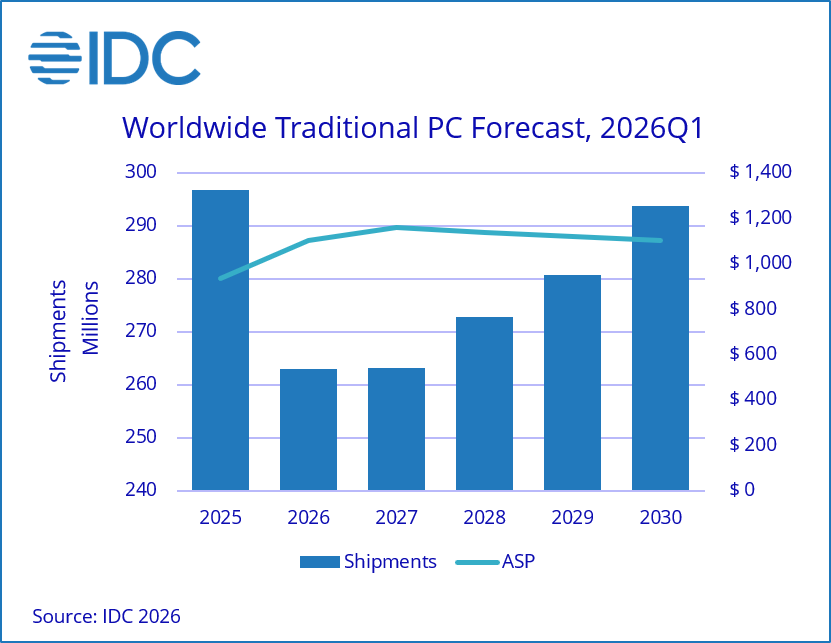
IDC blames a memory shortage with no real relief expected before the end of 2027. Prices, meanwhile, are only going one direction. And whenever prices for a particular niche get exorbitantly high, the already expensive brands seem value for money. For Apple, that meant high demand for their MacBook lineup.
Now, combine that with an already budget-friendly MacBook Neo, and it has no reason not to sell like hot cakes.
IDC hinted that the MacBook Neo will cause for an efficient Windows 11
IDC research manager Jitesh Ubrani said the MacBook Neo is “putting real pressure on the entire PC ecosystem,” and that vendors would likely respond with “a combination of new silicon, a more efficient OS from Microsoft, and aggressive promotional pricing.”
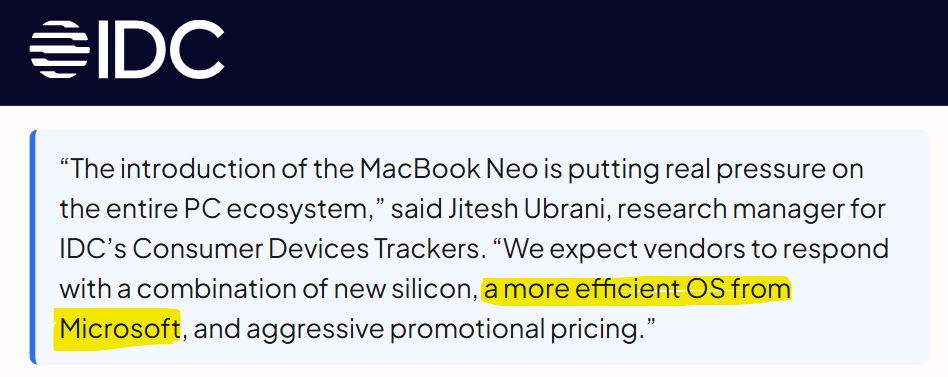
Of course, “a more efficient OS from Microsoft” means a RAM-optimized Windows 11. Note that the MacBook Neo was launched on March 4, 2026.
On March 20, during the landmark commitment to Windows quality initiative, Microsoft confirmed Windows 11 would use less RAM, but now the reasons have become crystal clear.
Apple’s vertical integration led to an 8GB MacBook Neo at a time when RAM prices are through the roof. Windows OEMs are forced to sell 8GB RAM at prices where they sold 16GB variants, but funnily enough, Windows itself wasn’t optimized for double the OS requirement.

As IDC mentions, “For vendors, the challenge is sustaining portfolio breadth while managing component scarcity and competitive pressure from Apple’s latest hardware.”, which leaves Microsoft with no choice but to reduce Windows 11’s RAM usage.
Microsoft is now optimizing RAM usage in Windows 11
On July 31st, Microsoft promised RAM optimization work for PCs with 8GB of RAM and above, aiming to finish by the end of 2026. Remember that optimizing Windows for 8GB RAM makes the OS even lighter for 16GB and 32GB.
About a month ago, Microsoft was already calling 8GB “great for everyday use like browsing, streaming, schoolwork, and productivity apps” on a Surface buying page.
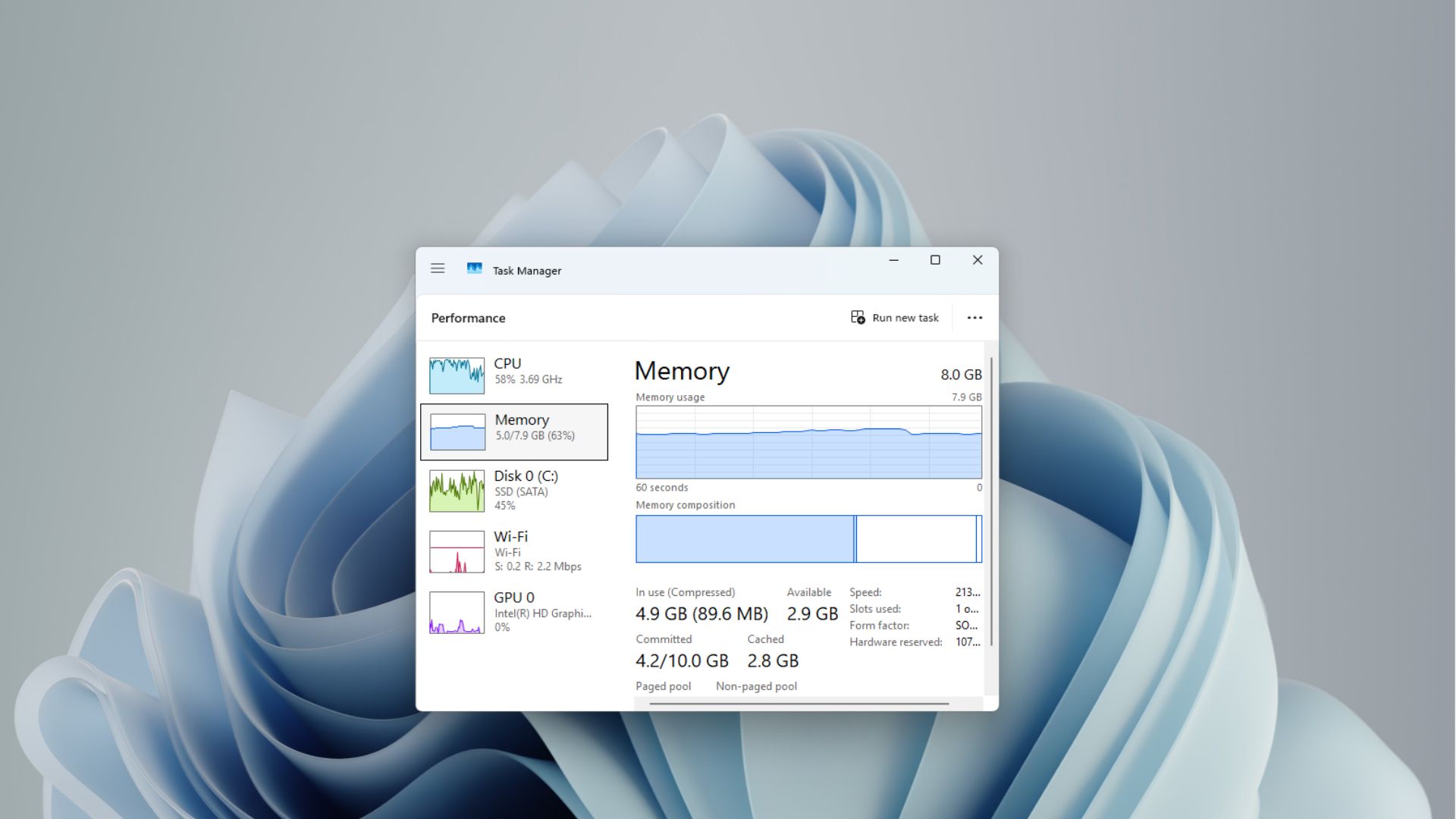
Microsoft can’t tell serious gamers to buy 32GB while also telling budget buyers 8GB is fine, not without a lighter OS to make both claims true at once, and that’s why Microsoft quietly deleted its own 32GB RAM recommendation documents from the Windows Learning Center.
The PC industry needs to sell 8GB RAM hardware
Two months after the MacBook Neo launched, a Microsoft-commissioned benchmark against the Neo found every OEM Windows machine tested shipped with double the RAM, more storage, and better port selection than Apple’s 8GB, 256GB, USB 2.0-bottlenecked machine.
Fast forward now and Microsoft’s unimpressive answer to Apple is the Surface Pro 12 and Surface Laptop 13. Both have 8GB configurations starting at $849 and $949, though neither qualifies as a Copilot+ PC since that branding still requires 16GB.
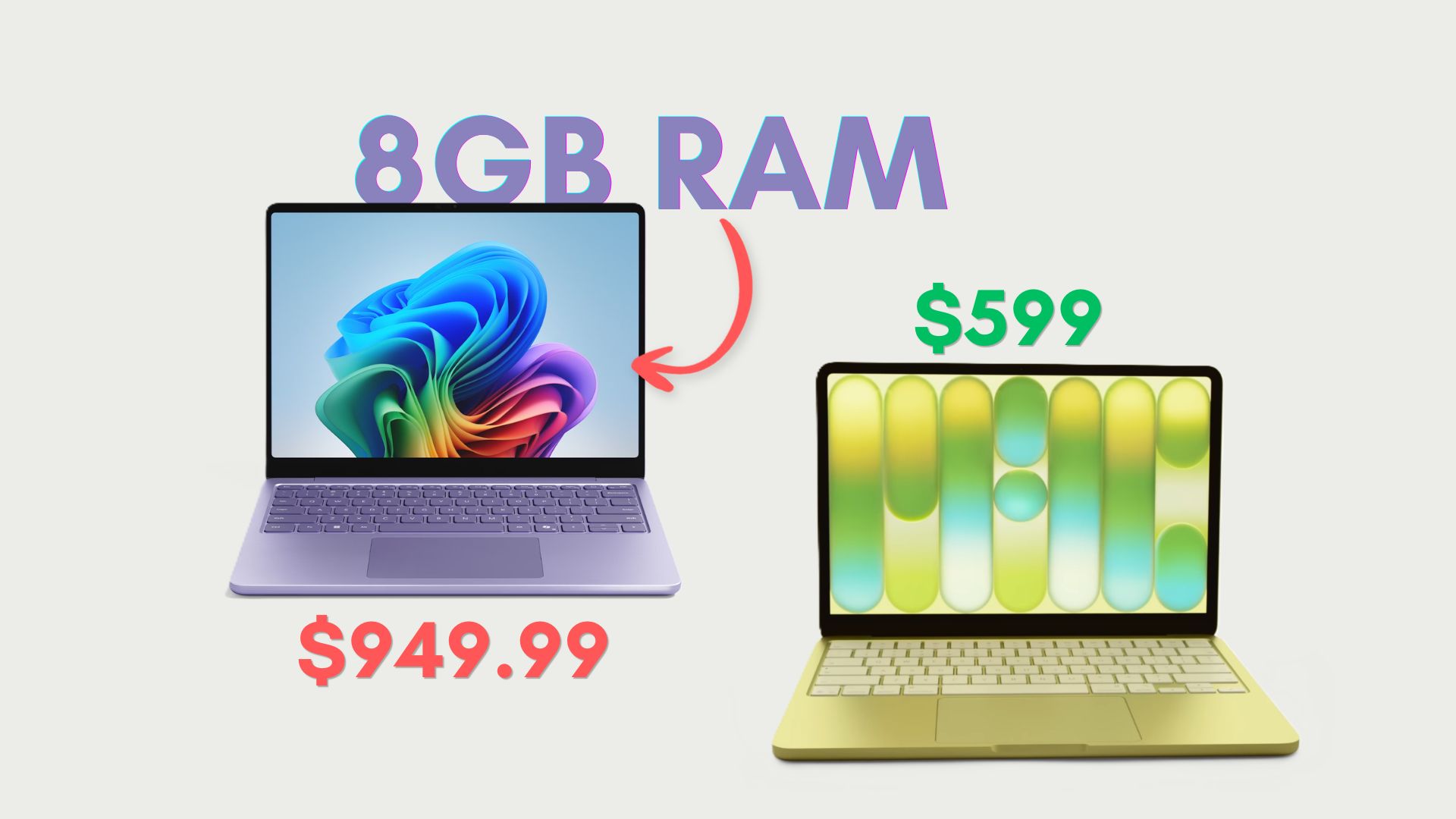
At least, it’s better than the absurdly priced Surface Laptop for Business with 8GB RAM selling for $1,299, more than double the Neo’s price!.
Dell fared much better. The new Dell XPS 13 starts at $599 for students and $699 for everyone else, directly matching the Neo’s price tier.
On paper, the PC industry proved it can build competitive hardware at this price. But there’s just one place Windows PCs still can’t keep up.
Microsoft still has a real problem to solve
Even with better specs on paper, Windows 11 PCs lose on performance. Independent lab testing found Microsoft Word opens twice as slow on Windows 11 laptops as on MacBooks, an app Microsoft has had three decades to optimize for its own OS.
The problem, for Microsoft, is two-fold:
- Apple Silicon is still meaningfully ahead of what Intel, AMD, and Qualcomm ship today.
- macOS is more optimized to open certain apps faster, even on 8GB RAM.
Panther Lake and Snapdragon X2 are closing the gap on the hardware side of things. And Nvidia’s RTX Spark could shake things up further. But the RAM crunch makes chip-level leaps expensive and slow to arrive. So, making Windows 11 leaner is the one lever Microsoft can pull without waiting on silicon upgrades.
Fortunately, Microsoft has been spending its effort exactly there, replacing legacy Win32 and WebView2-based components with the native WinUI framework across File Explorer, Print Management, and the Properties dialog, all of which directly reduces the memory and performance tax in Windows 11.