









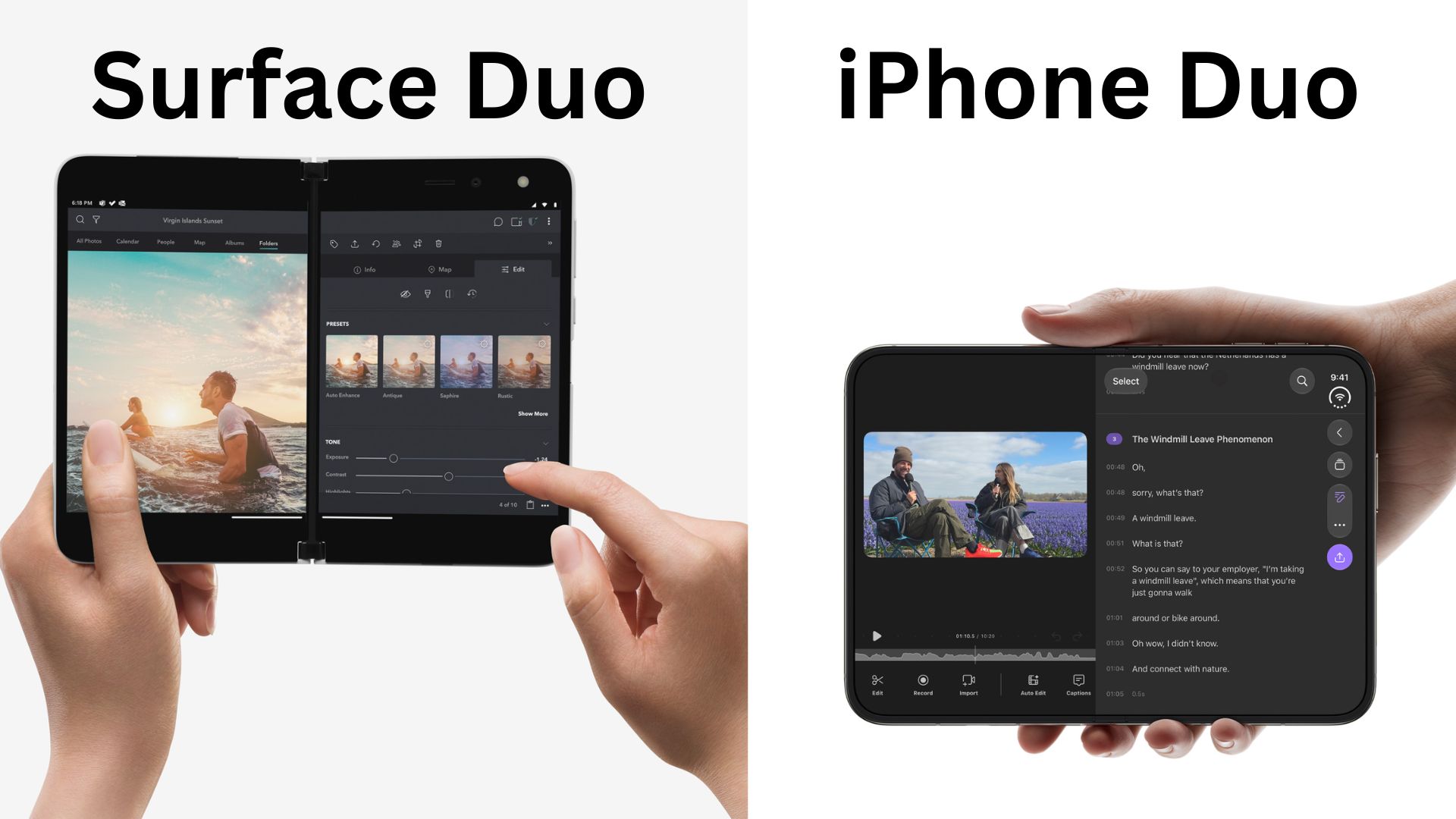
Turns out, it isn’t just the name that the iPhone Duo copied from the Surface Duo. Apple got “inspired” by all the market research Microsoft did more than half a decade ago and used many of the same marketing materials that the original Duo had during its official release on September 10, 2020. Yes, 6 years to the day!
As soon as I started watching the iPhone Duo part in the Apple event, I was convinced that Cupertino copied Redmond’s homework. It was the way Apple chose to present the product: the Duo opened like a miniature notebook, used as two working surfaces, propped at different angles, used hands-free, paired with a stylus, running two things at once, transitioning between postures as a phone that becomes a larger productivity device.

To me, it was Déjà vu. Those are the scenarios Microsoft showed with Surface Duo presentations around 2020, described as a device with two screens that could be used separately or together, with Book, Compose, and Tent modes, side-by-side apps, App Groups, and drag-and-drop between screens.
At this point, I feel Apple could’ve copied the release date too; instead, they chose September 9, 2026, a day before the Surface Duo’s anniversary.
Watch the original Surface Duo promo video and see if you notice the parallels:
The name Duo
I totally understand that Apple can’t name it Fold, because that’s what every other manufacturer calls their version. Apple’s “crack marketing team” had to use the ever-so-iconic Duo from Microsoft!
The Surface Duo is a Duo because it has two identical screens, working like you have a secondary monitor. Perfect name.

iPhone Duo has one large inner screen and a smaller outer screen, but the folding OLED can act like two separate screens, with the multitasking setup (more on that later). And there are many functionalities where the one inner screen acts as two screens, while also using the front screen, such as the Kid Cue. So, doesn’t that make it a Trio, and not a Duo?
To some, the iPhone Duo may sound perfect, but to me, it’s not.

Apple didn’t invent the passport-sized dual-screen productivity device
On April 27, 2020, a bunch of YouTube creators posted a “first impressions” video of the Surface Duo, but weren’t allowed to show the software (yes, I’m foreshadowing here). Watch any of those videos, and you’ll see them raving about its hardware, especially the hinge.

MKBHD said: “I think this is the nicest hinge I’ve ever used in a piece of tech.”
He was reacting to a 4.8mm-per-side open, 9.9mm-closed device weighing 250g, with two 5.6-inch AMOLED panels joined by a 360-degree hinge, a fingerprint reader built into the side button, no outer display, Surface Pen support, and the ability to stand at almost any angle.

It’s the passport-style form factor the Surface Duo used. Apple even describes the new iPhone as similar in size to a passport. Apart from the silhouette, the designs aren’t identical: Surface Duo used two separate rigid displays with no external display, folding a full 360 degrees so one panel faces outward, while iPhone Duo uses one flexible inner display plus a 5.4-inch outer display with a conventional book-style fold. But fold the Surface Duo all the way around so only one display faces out, and you get a strikingly close, thin, flat, passport-like slab to Apple’s closed Duo.
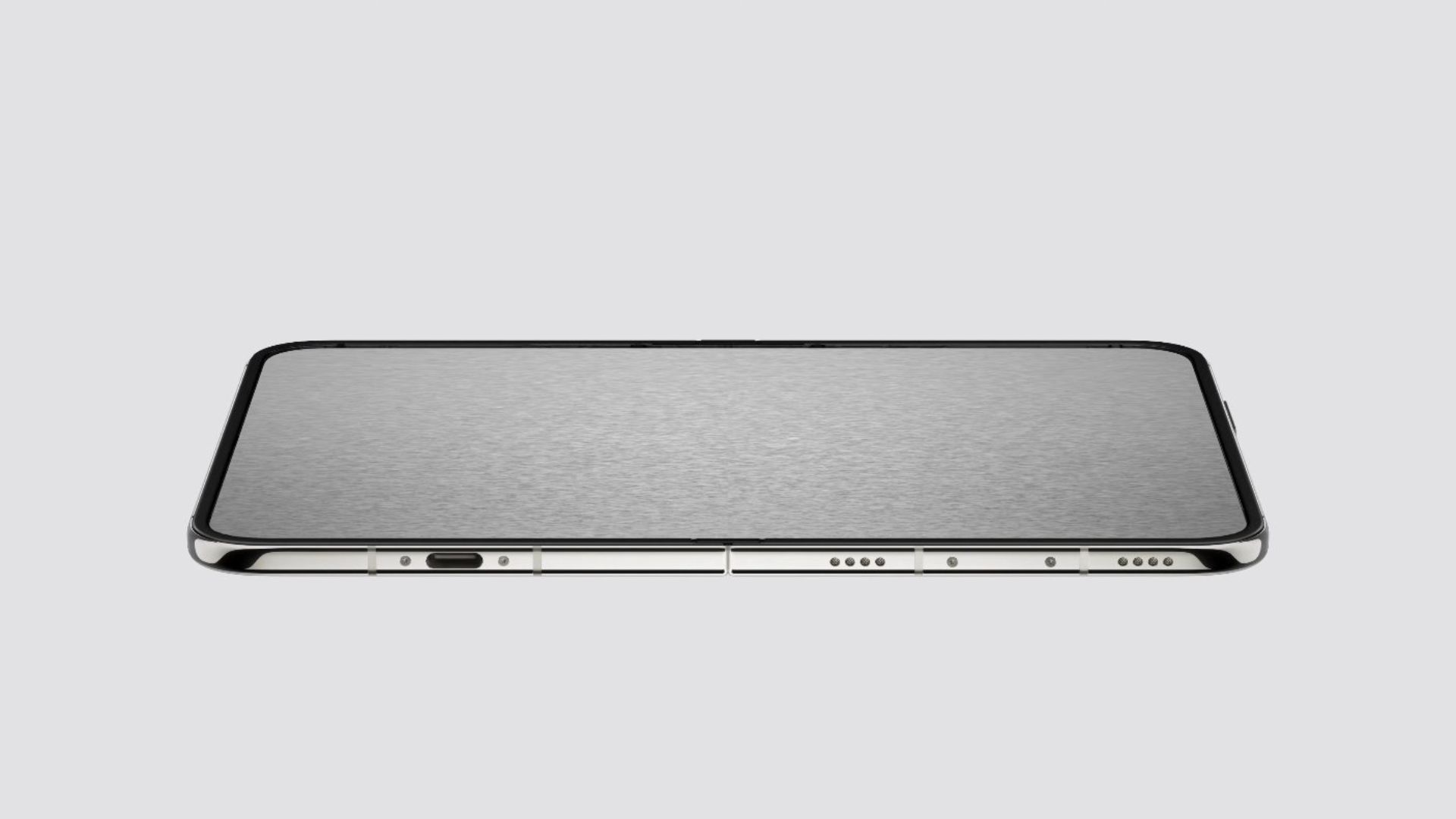
Personally, I don’t like the asymmetric look when closed on the iPhone Duo, but it’s what the Surface Duo had too. At least there, there wasn’t anything on the front except Microsoft’s logo under glass. I loved it back then, and I wish it was still available.
Then there’s the side-mounted Touch ID. Apple spent years making Face ID central to the iPhone, and its foldable drops that for a side-button Touch ID sensor. The original Surface Duo had a fingerprint reader in its power button back in 2020, another strange moment where a 2026 iPhone goes back to an obvious solution Microsoft was already using six years earlier.

Surface Duo supported the Surface Pen and Slim Pen, and Microsoft marketed the device as a digital notebook. Samsung’s foldables still don’t offer S Pen support on the base Fold line, so Apple did clear a bar Samsung hasn’t, though stylus support on a foldable isn’t unique to Microsoft either; Lenovo and others got there too. But the fact is that there was the Surface Pro, and its pen could be used with the Surface Duo; then there’s the iPad, and its pen can be used with the Surface Duo.
Then there’s the price. Microsoft wanted $1,399 for the original Duo in 2020. Adjust for inflation, and it’s around $1,700 today. Apple wants $1,999.
You can argue the Surface Duo has no front screen while the iPhone Duo does, but you can pay extra for Apple’s expensive folio case that hides that front display, and it matches the Surface Duo perfectly. Of course, I’m being facetious.
The Surface Duo bumper case, arguably, still did more with less.

I’m comparing a 2026 foldable with one from 2020, but don’t let me get started with the recent ones. The original Samsung Galaxy Fold is in its 8th iteration now, and there’s no single hardware innovation in Apple’s foldable that outshines Samsung’s after 7 years of Apple working on this.

It gets more absurd looking at China. The Xiaomi 18 Fold (terrible name, by the way) looks nearly identical to the iPhone Duo, but packs a 3.5x telephoto lens, a 200MP main camera, and a 6000mAh silicon-carbon battery, all while being thinner at 5.02mm, a fraction of a millimeter, but it’s Apple who called this their thinnest iPhone to date.
Every hardware feature the iPhone Duo has was already done years prior by Samsung, Oppo, OnePlus, Vivo, and Xiaomi. Software is supposed to be where Apple shows off its own innovation. As it turns out, Apple took plenty of ideas from the original Surface.
Apple borrowed the Surface Duo’s software pitch
Apple’s keynote describes the iPhone Duo as combining “the utility of two products into one.” Microsoft’s Surface Duo pitch was almost the same idea: a single-screen phone forces users to constantly switch between apps, “breaking focus, breaking flow,” while two screens work “just like using two monitors at your desk.”
Multitasking is where the Duo nailed it: both of them.
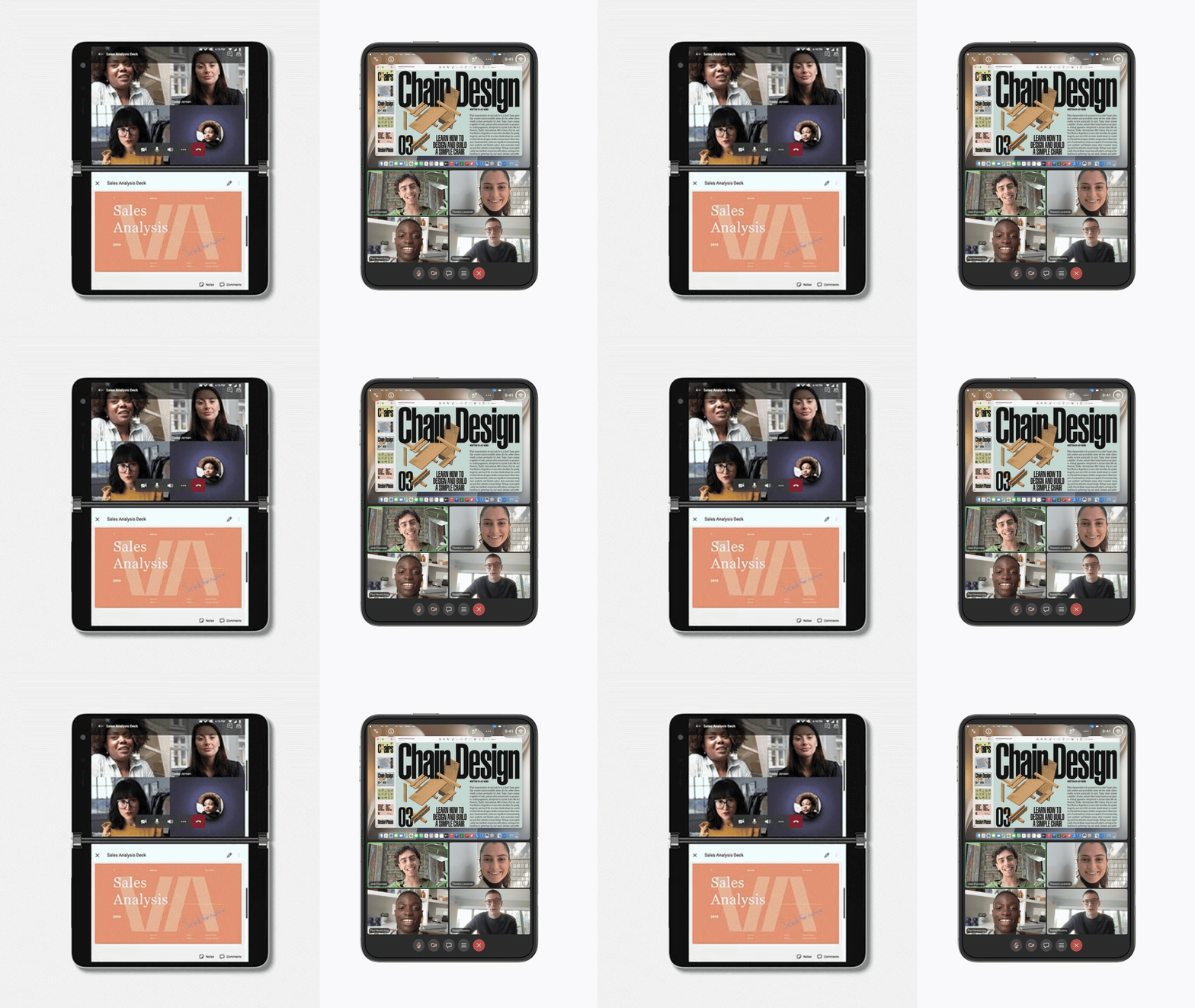
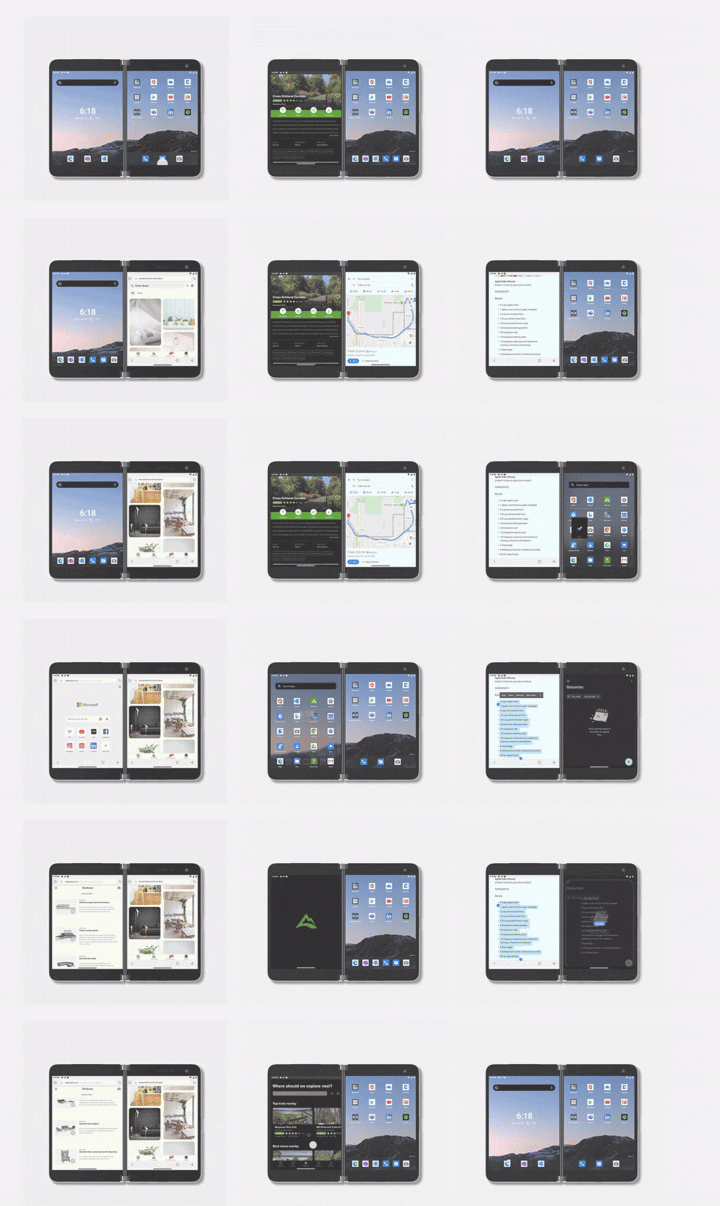
Apple calls its version Split View, letting users put two apps side by side, open two windows of the same app, and save app pairs to return to later with a tap. Surface Duo had this in 2020 through App Groups, pairing two apps to launch together, one per display, with drag-and-drop between screens. Microsoft called them App combos. Apple calls them paired apps.
Apple’s iPhone Duo multitasking:
App combos in Surface Duo was a standout feature:
The buttons look different, but the idea is remarkably familiar, though Apple runs it on one flexible display, while Surface Duo had two fully independent panels.
Posture-aware software might be the strongest parallel here. Apple spends a lot of time explaining how iOS reacts when Duo is fully open, partially folded, turned sideways, flipped, set on a table, or used hands-free, sliding content away from the fold and reorienting based on sensors in each half.

Microsoft did this with Book, Compose, Tent, Peek, and single-screen modes in 2020, and still describes folding the Duo like a tent for hands-free video or Teams calls in its support documentation. Software adapting to a foldable’s posture isn’t Apple’s invention. Microsoft built a whole vocabulary around it six years earlier.
Hands-free video is almost comically similar. Apple shows the Duo propped up on its own for calls and shows. Microsoft showed the identical setup with Tent mode, including hands-free Teams calls, well before most of the market was paying attention.


Microsoft also marketed the Duo as something you could open like a book and use Kindle to “read a book like a book” across the two displays. Apple didn’t call the iPhone Duo a notebook, but considering the iPad comparisons, Apple Pencil support, and mentioning the big screen as a canvas for notes and documents, it arrives at the same use case.

Microsoft showed Apple how to make the Duo useful, but tragically didn’t keep going
Surface Duo 2 fixed a lot of the original’s shortcomings: a Snapdragon 888, 5G, NFC, 90Hz displays, a combined 8.3-inch curved display, a triple rear camera (which the iPhone Duo doesn’t have), Slim Pen 2 support, and a Glance Bar for notifications on the hinge.
However, it still had UI bugs and an unforgiving $1,500 price. Microsoft was still improving the concept when it walked away.
iPhone Duo proves that Microsoft was totally right about the concept and the marketing around it. Apple is the uncrowned king when it comes to marketing, including shady patterns of controlling the narrative, like how they completely avoided showing the keyboard on the outer display, probably to prevent showing the difficulty of using a superwide keyboard. Surface Duo promo images showed them, though!
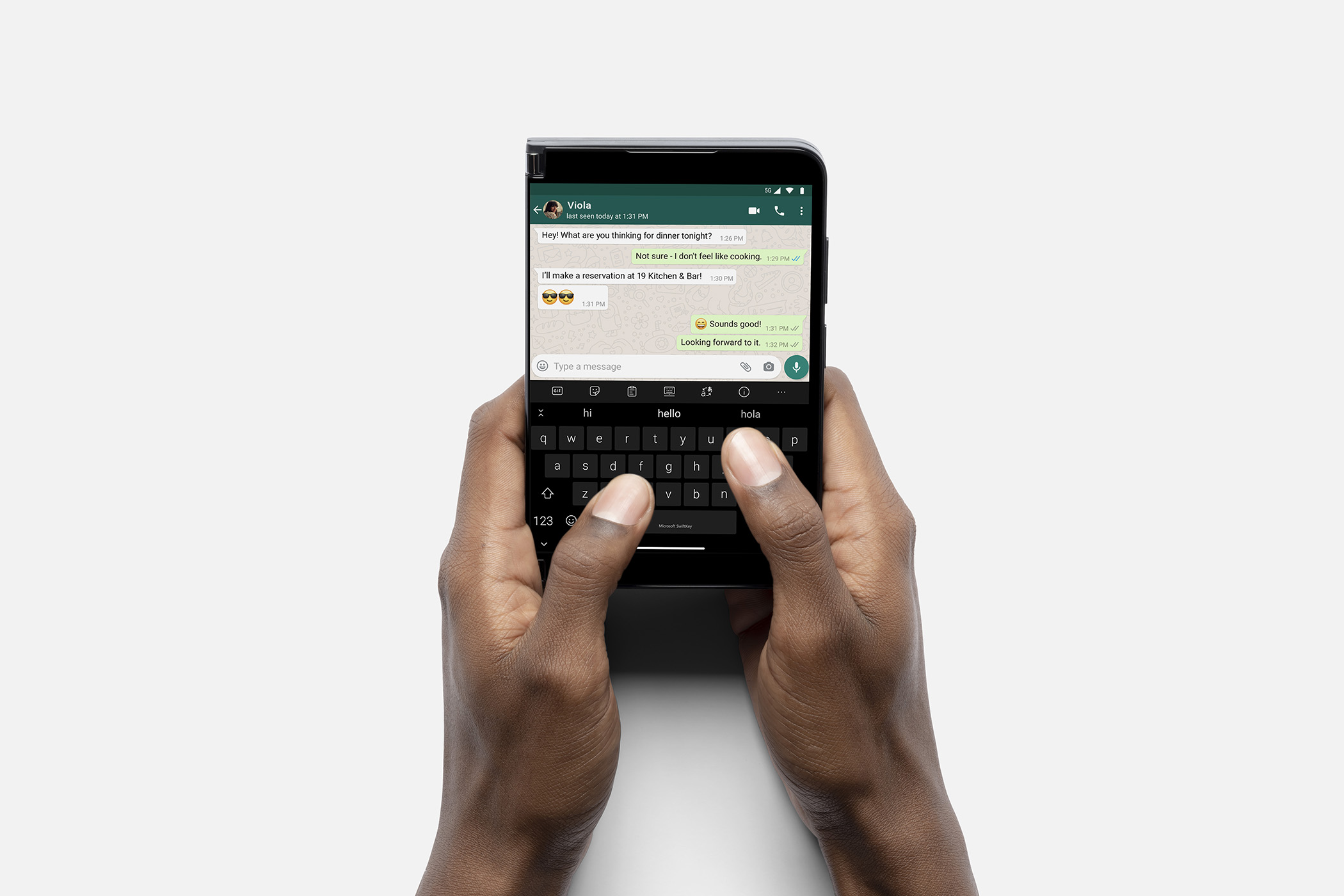
Microsoft’s 2020 research wasn’t “two screens are cool.” They studied multitasking, cognitive load, app switching, reading, note-taking, email, meetings, shopping, navigation, and cross-device workflows in detail.
Apple is now selling many of those practical scenarios as reasons to buy a foldable iPhone, which, for a Surface fan like me, makes it feel more frustrating than watching another company launch a foldable.
Apple gets to finish the experiment
To be fair to Apple, the iPhone Duo’s hinge, its flexible OLED, the nano-texture display, the durability, the thermal design, A20 Pro, and the iOS adaptation work are Apple’s own impressive engineering, especially on the software stack.
What Apple seems to have copied, intentionally or not, is the homework Microsoft did on what people want to do with a device like this: a pocketable productivity machine. If Apple took this long to make a foldable, I am in every right to expect a revolutionary device, and the iPhone Duo isn’t one.
Microsoft had all of that, including a second-generation device demonstrably better than the first, before giving up on the category. If someone from Microsoft is reading this, remember that you are always early to the party, but it doesn’t mean you should quit. If Microsoft can make Windows 11 better from what it was in 2025, they can surely bring back the Surface brand to its roots.
As for what I have to say to Apple, I guess it’s the Surface Duo’s tagline: Do one better.