









Microsoft says it will let users apply an Outlook Classic-like interface to New Outlook using built-in themes, hoping that making it look more familiar will make the transition easier.
Microsoft will probably never acknowledge that it might have made more sense to improve Outlook Classic, or even the modern Mail & Calendar app, instead of building the web-based New Outlook for Windows. But the rest is history.
New Outlook has been around for three years now, and it has improved significantly in recent months. However, Microsoft is still spending time adding features that have existed in Outlook Classic for years, such as offline support and the recently added support for PST files.
Microsoft is still working to bring more Outlook Classic features to New Outlook, which is also why it delayed the forced installation of New Outlook on enterprise PCs until early 2027. But there’s one thing the company cannot replace with a feature update, and that is the look and feel of Outlook Classic.
A new version of Outlook is rolling out with a toggle called “Outlook Classic” under Settings > General > Appearance.
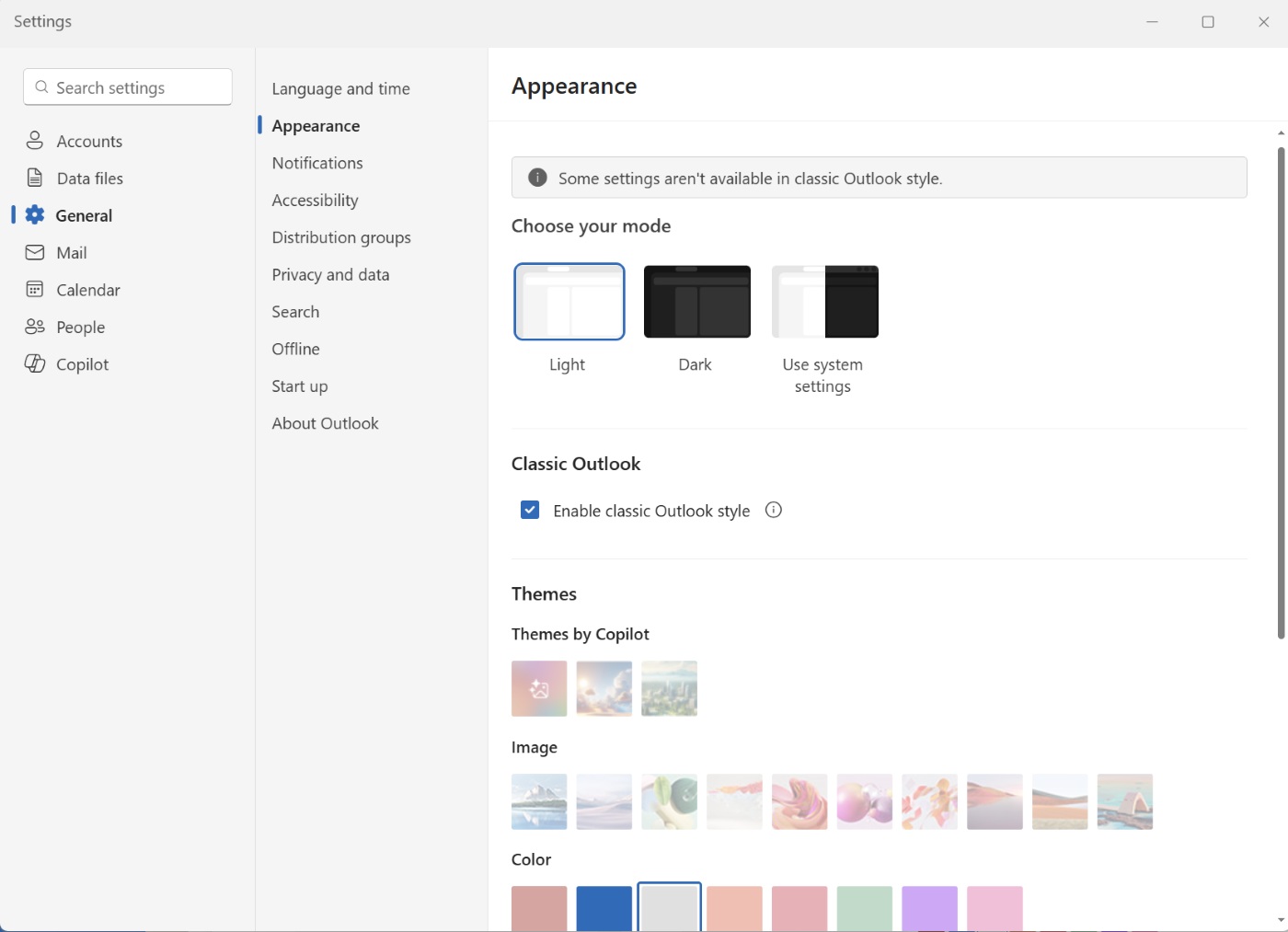
When enabled, New Outlook will mimic the visual style of Outlook Classic, and Microsoft hopes this familiarity will make the transition easier for users who are hesitant to move away from the older client.
I wasn’t able to enable the “Outlook Classic” theme because the feature is still being rolled out, but don’t expect a dramatic transformation. At the end of the day, this is still just a theme.
A theme can change visual styling, layout, icons, and some interactions, but it cannot recreate the underlying Outlook Classic experience because the two apps are built differently. Outlook Classic is a native Win32 application, while New Outlook is based on WebView2.
New Outlook is getting the “Outlook Classic” theme, and it’ll remain a web app
Microsoft officially says the new theme will update “visual styling, layout, typography, icons, and selected interactions” to better match Classic Outlook, but it has no plans to build a native email client instead.
“We’re introducing a new optional setting in Outlook on the web and the new Outlook for Windows that adjusts the experience to more closely resemble classic Outlook for Windows,” Microsoft noted. The company explained that the goal is to help users moving from Classic Outlook without changing the capabilities of the modern version.
The “modern version” Microsoft refers to is, of course, New Outlook.
Microsoft says the toggle will roll out to all New Outlook users and can be enabled or disabled at any time. It won’t be turned on by default for most users, but Microsoft may use the setting as part of its transition strategy for users who are strongly attached to Outlook Classic.
For example, if a user who prefers Classic Outlook eventually tries New Outlook or is moved to it, Microsoft could automatically enable the classic theme to make the experience feel more familiar.
“As part of a phased rollout, Microsoft will enable the setting by default for some users moving from classic Outlook to the new Outlook. Those users can change the setting at any time,” the company explained.
Microsoft also clarified that the theme does not change the actual interface or behaviour of Classic Outlook, as the feature only applies to Outlook on the web and New Outlook for Windows.
It is also worth noting that this feature will not force you to use New Outlook if it is installed separately from Outlook Classic.
“This feature does not automatically migrate users from classic Outlook to the new Outlook and does not affect or override any existing administrator configurations used to manage new Outlook availability or migration experiences,” Microsoft noted.
The company still plans to move users toward New Outlook in 2027, but there will be an opt-out option. However, users who opt out may need to do so again in the future if Microsoft starts another migration attempt.