




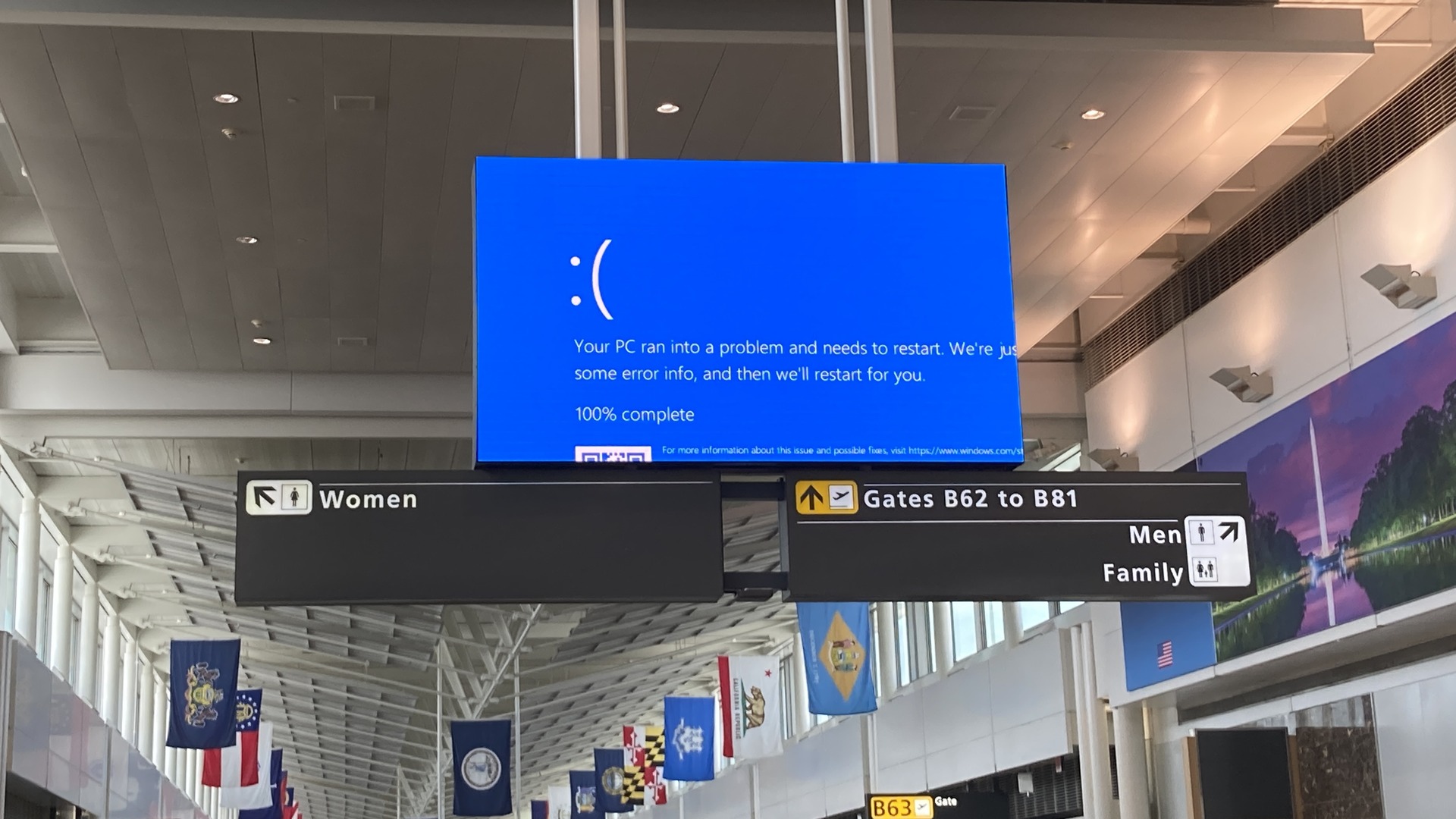
More than two years ago, a faulty update to a popular security product crashed approximately 8.5 million Windows devices, and it left us staring at the Blue Screen of Death everywhere, including airports. Two years later, Microsoft says it’ll now let third-party antivirus products run supported functions outside the Windows kernel, so issues like this are less likely to happen.
If you can’t recall, that dark, or rather the “blue” day was July 19, 2024, when CrowdStrike, a famous security company, rolled out a faulty update to its Falcon Sensor security software.
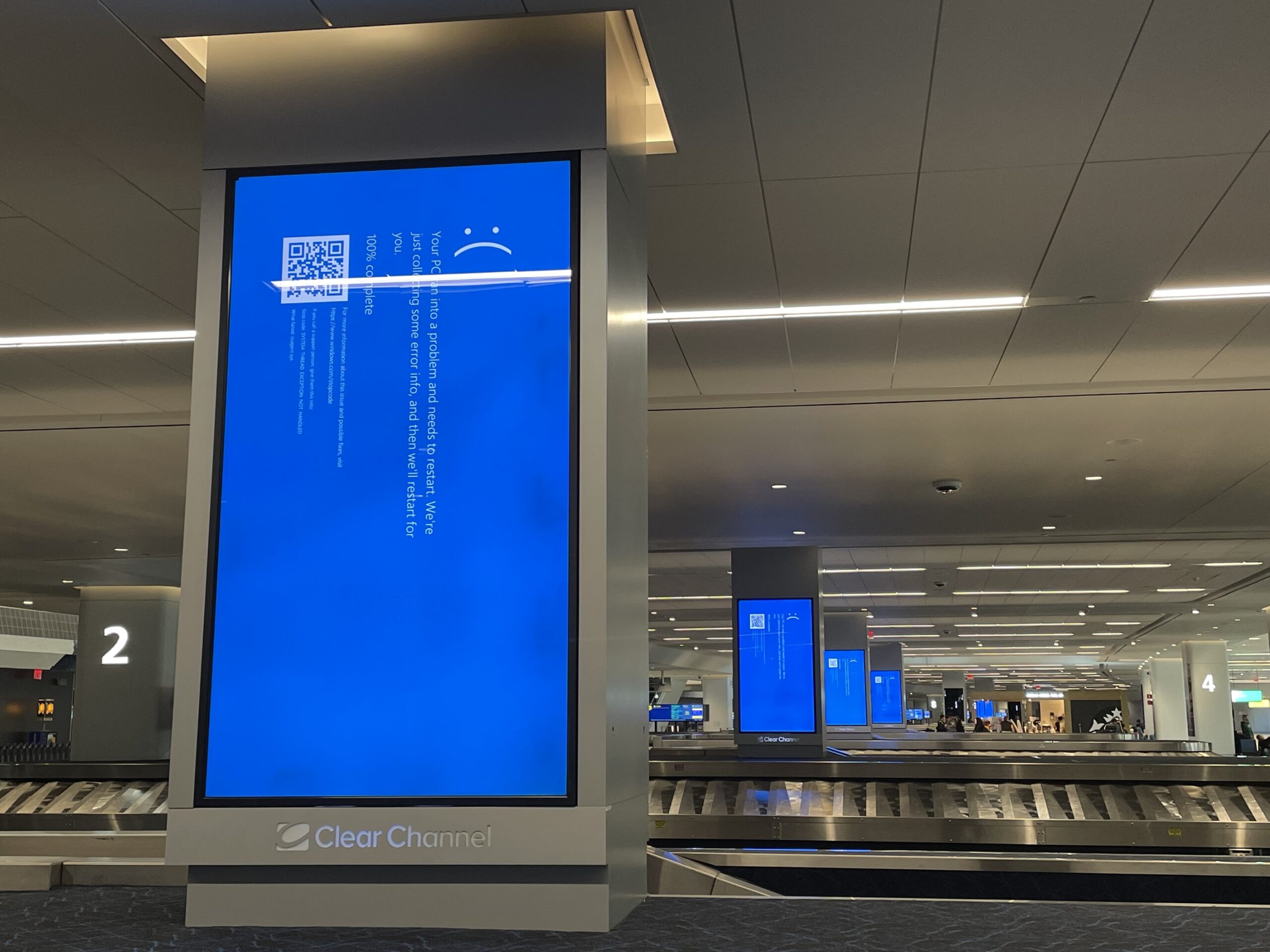
As soon as some companies installed the update, they were left staring at the famous Blue Screen of Death, and close to 8.5 million devices at airports, hospitals and elsewhere were hit.
Since Windows is used on over a billion devices, and third-party security solutions are installed on millions of PCs, outages were experienced worldwide, and it cost billions of dollars in damage. More than the dollars, it was a wake-up call for the industry, particularly Microsoft, that a bug in security software could disrupt the world’s operations, and something needed to be done to reduce those pesky blue screens.
As Windows Latest reported at the time, businesses, schools and media companies using Windows were among those affected. We also observed that some hospitals and even emergency services had outages as Windows crashed.
1% of all Windows PCs were offline
At that time, Microsoft estimated that less than 1% of all Windows devices were affected by the outage, and that makes sense because CrowdStrike’s security products are mainly used by businesses.
Once affected PCs were stuck in a boot loop, you’d often need to rely on Windows Safe Mode or the recovery environment and then remove the problematic file, which was time-consuming. That led to Microsoft releasing a bootable recovery tool to speed up repairs.
Two years after the disaster, Microsoft says it’s finally rolling out a new feature that changes how antivirus software works on Windows. At Ignite 2026, Microsoft explained that companies can now run parts of their security products outside the Windows kernel, which should reduce BSODs. And several security vendors are already on board.
In a separate announcement, Microsoft’s Windows security lead Dana Huang called the platform “an important milestone in Microsoft’s work with the security ecosystem to reduce reliance on kernel drivers while preserving the capabilities security solutions depend on.”
How Microsoft is moving antivirus protection out of the kernel
The Windows kernel is the heart of the operating system, as it sits at the core and takes care of hardware, memory and other features. Historically, it’s never been a good idea to run a third-party product that interferes with the kernel, as when something goes wrong, it can take down the entire system with it.
“Historically, some security protections ran in the Windows kernel, where one failure could affect the entire device,” Windows boss Pavan Davuluri explained.
That includes anti-cheat software, which has in the past been associated with Windows update compatibility issues and BSODs. Some anti-cheat software still uses kernel components. Security products have also used kernel components, and they have a valid reason, which is to monitor everything across the system and stop threats before they can do damage.
On the other hand, when you run a regular app that doesn’t use kernel components, it runs in user mode, which is more isolated. So when the app itself is buggy and crashes, it doesn’t normally bring the whole system down. In the worst-case scenario, you can be left with a few unresponsive windows or a buggy desktop, but you wouldn’t normally be staring at a blue screen.
It’s all good until security software does its job and is not botched up itself. We’ve seen what happens when security software accidentally takes down the Windows kernel in the past.
Microsoft’s solution is called the Windows endpoint security platform, where security vendors are given a set of Windows APIs they can use from user mode.
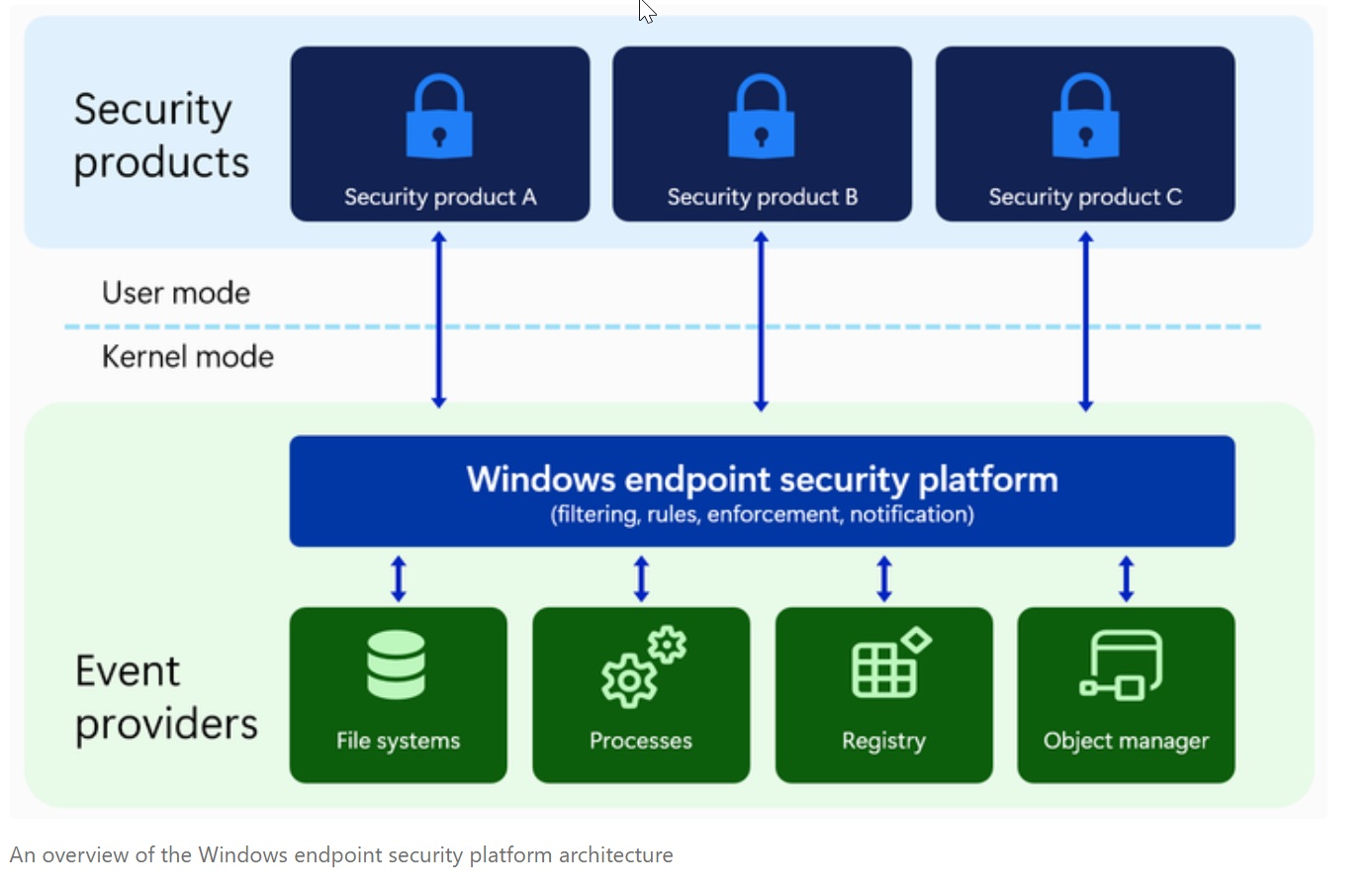
Windows takes care of the connection to the system, and the security product can receive notifications, apply its rules and block activity where appropriate.
“The platform provides filtering, notification and enforcement capabilities needed for security scenarios,” Microsoft explained in a document seen by Windows Latest.
“This change will help security developers provide a high level of reliability and easier recovery resulting in less impact on Windows devices,” Microsoft said in a 2025 post about the platform.
Microsoft confirmed that its new APIs will initially allow security vendors to monitor file systems, processes, the Windows registry and Object Manager, which manages system resources. For these supported functions, vendors don’t need to put all of their own code in the kernel, so if a third-party vendor accidentally pushes out a bug, it’s less likely to break the kernel itself.
At the same time, security products can still continue to work normally, including monitoring supported events without having to put all of that functionality in their own kernel components.
ESET, Microsoft Defender and other products are adopting it
Microsoft says Windows Defender, ESET, CrowdStrike and other security vendors, like Bitdefender, are adopting this new API, and they plan to roll it out to their security products in the coming months.
Here’s the planned timeline I found:
| Security provider | Product | Planned availability |
|---|---|---|
| Bitdefender | Bitdefender Antivirus Free | Q4 2026 |
| CrowdStrike | Falcon | Q1 2027 |
| ESET | ESET Endpoint Protection | February 2027 |
| Microsoft | Microsoft Defender | Q1 2027 (preview) |
| SentinelOne | Singularity | First half of 2027 |
| Sophos | Sophos Endpoint | Q4 2026 |
| Trellix | Trellix EDRF | First half of 2027 |
| TrendAI | TrendAI Vision One | First half of 2027 |
CrowdStrike is also confident that Windows 11’s new approach towards security products and kernel integrity will “augment the kernel-level protection Falcon customers already count on,” which also makes clear that adopting the new APIs doesn’t necessarily mean Falcon will abandon kernel-level protection entirely.
Likewise, Bitdefender confirmed it will begin rolling out support for Windows APIs later this year, with broader availability in early 2027. Another important vendor, Sophos says it’s working on an integration that will help block malicious or untrusted drivers as Windows starts using the new platform.