








A week before Microsoft 365 went down for a staggering 30 hours, an Azure engineering lead posted a long thread on X explaining why Microsoft’s products are sometimes unpolished (for not wanting to use an indecent word), and no, it’s not because of AI, which even Microsoft wants you to understand. He also didn’t blame the engineers.
The Outlook outage was a clear example of how much the world depends on Redmond. But Slava Akhmechet, who heads Azure MySQL engineering, says Microsoft runs at an unfathomably absurd scale that its attention goes to giant enterprise customers and billion-dollar deals first, and all the “warts” that you and I complain about get pushed down the long list.

Windows Latest spotted the thread, which has now crossed half a million views, and I found several current and former Microsoft employees either agreeing or pushing back. On November 12, Outlook, Teams, and Exchange Online fell over worldwide, and I revisited the thread and spent hours going through all the replies and quoted reposts.
So, the question has to be asked. If Microsoft has some of the best engineers and the deepest pockets, why does so much of its software and services still suck?
Microsoft operates at a scale where a $100 million product barely even matters
Imagine you’re working at Microsoft and leading a product that brings in more revenue than most companies making similar products. Sadly, your product isn’t even a footnote on executive slide decks, as Slava says that leadership only pays attention once you cross $1 billion. He compares Azure’s roughly 250 services to an imperial navy, with ships of every size stretching to the horizon.
Of course, my first thought was to dismiss this as an engineer hyping his employer, but then I looked at Microsoft’s numbers. As Slava said, the software giant’s fiscal 2026 annual report confirms that Azure crossed $100 billion for the first time, up 41%.
Then there was a wild claim in the thread that said Microsoft stamps a new data center into the ground every four days. I assumed that was an exaggeration until I did the math. During their July earnings call, Microsoft said they added 88 new data centers in fiscal 2026, which works out to one every 4.1 days. CFO Amy Hood also said on that call that customer demand continues to exceed available capacity, which is Slava’s point about Azure being forever short on capacity.

However, I couldn’t find Microsoft’s confirmation about some numbers that he mentioned, like the smallest Azure services running on 10,000+ virtual machines and half of engineering time going into reliability.
Anyway, the point is that if a nine-figure business can go unnoticed by leadership, imagine the odds of your Teams bug getting attention.
Microsoft’s biggest customers decide which problems get fixed, according to its employees
In his third point, Slava wrote that Microsoft is totalitarian about serving the customer, and its product warts come from that culture. His example was the Azure Portal, which he said would be easy to improve, but no customer or partner had ever complained to him about it.
Well, the internet had a lot to say about that. Chris Clark, Co-founder and COO of OpenRouter, replied that his company complains about the portal all the time, and “It’s a running joke with our support team at Microsoft.” His company even moved projects to other clouds because nobody could figure out how subscriptions, regions, and resource groups fit together.
Funnily enough, Sergio Mattei, who now works at OpenAI and worked on the Azure Portal, replied that “we complained about it… a lot… while working to fix it.” Slava’s witty response was “Let’s just say I stick to az cli,” which is Azure’s command-line tool.
What I noticed is Slava agreeing that the portal is bad. He later explained that Microsoft’s ideal customer is the huge traditional enterprise, and the further you are from that profile, the worse Microsoft serves you. As for the portal complaints, he said “it doesn’t matter at all because Walmart and Coca Cola don’t care.”

Another user guessed the portal costs Azure at least $10 billion a year as developers pick AWS or Google Cloud instead. It’s a random guess, of course, but Slava replied that the long-term cost is probably even higher, and Microsoft makes this choice deliberately.
Adam Prout, a Distinguished Engineer at Microsoft who co-founded MemSQL (now SingleStore), mentioned the Azure Portal, Teams, Windows UX, Word’s web UI, Azure DevOps and even VS Code as products with fit-and-finish problems, adding that “Hangs or random annoying UX bugs don’t get priority.” Database teams obsess over reliability because customers demand it, he says, but other products don’t face that pressure from buyers.
As someone still holding on to Outlook Classic because the new Outlook is a web app, I wasn’t surprised to see Word’s web UI on that list. And we’ve lost count of how many times Microsoft has broken Windows 11’s most basic features this year.
Matt Ryall, an ex-Atlassian who now runs Mawson Rovers, said exactly what I concluded from the replies, “the buyer and the user are different people with different needs.”
The Microsoft 365 outage shows why “just fix it” rarely works at Microsoft’s scale
Slava’s fifth point is about how complicated Azure is. A managed Postgres database depends on compute, networking, Kubernetes, and more, each of which depends on a dozen other things, so when one piece breaks, everything above it can break too. Even a construction crew cutting a fiber cable in Brazil can do it. To avoid circular dependencies, Azure services are arranged in rings, and each can only depend on its own ring or lower ones.
I also spotted a reply that I didn’t expect to see. Microsoft’s official Azure account: “The complexity is real, and so is the commitment to reliability, security, and customers.”
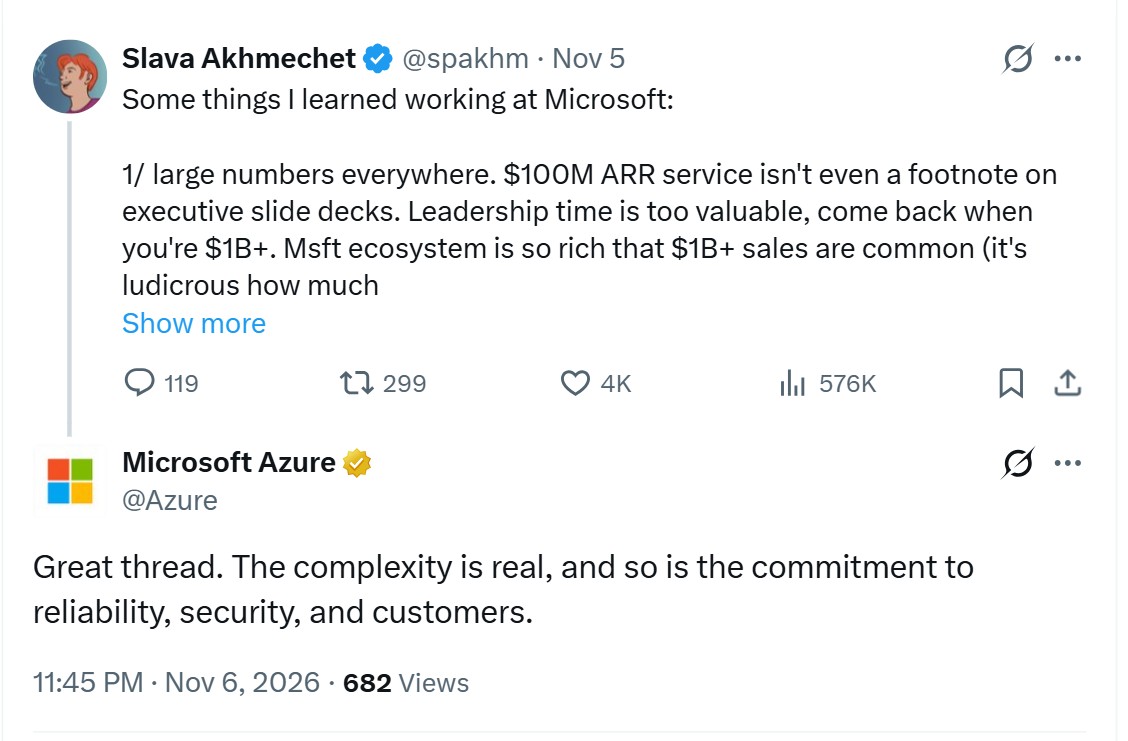
A week later, Microsoft 365 users found out how real. Microsoft’s incident record puts the Microsoft 365 outage between 5:05 AM ET on November 12 and 11:10 AM ET on November 13, and it took down Outlook, Teams, SharePoint, Copilot and Exchange Online. Outlook greeted us with a “Your request can’t be completed right now” error too.
According to Microsoft, servers were suddenly becoming unavailable and piling load onto the rest, as a core process on them got overwhelmed. At one point, even the virtual machines it spun up for extra capacity got stuck in a bad state.
Eventually, Microsoft traced it to an earlier network capacity upgrade whose issue only showed up after a later network change, and it went out of its way to say the outage was “not related to cyber or AI / agents.” It also restored services in stages, checking stability at each step, which is why recovery dragged on.
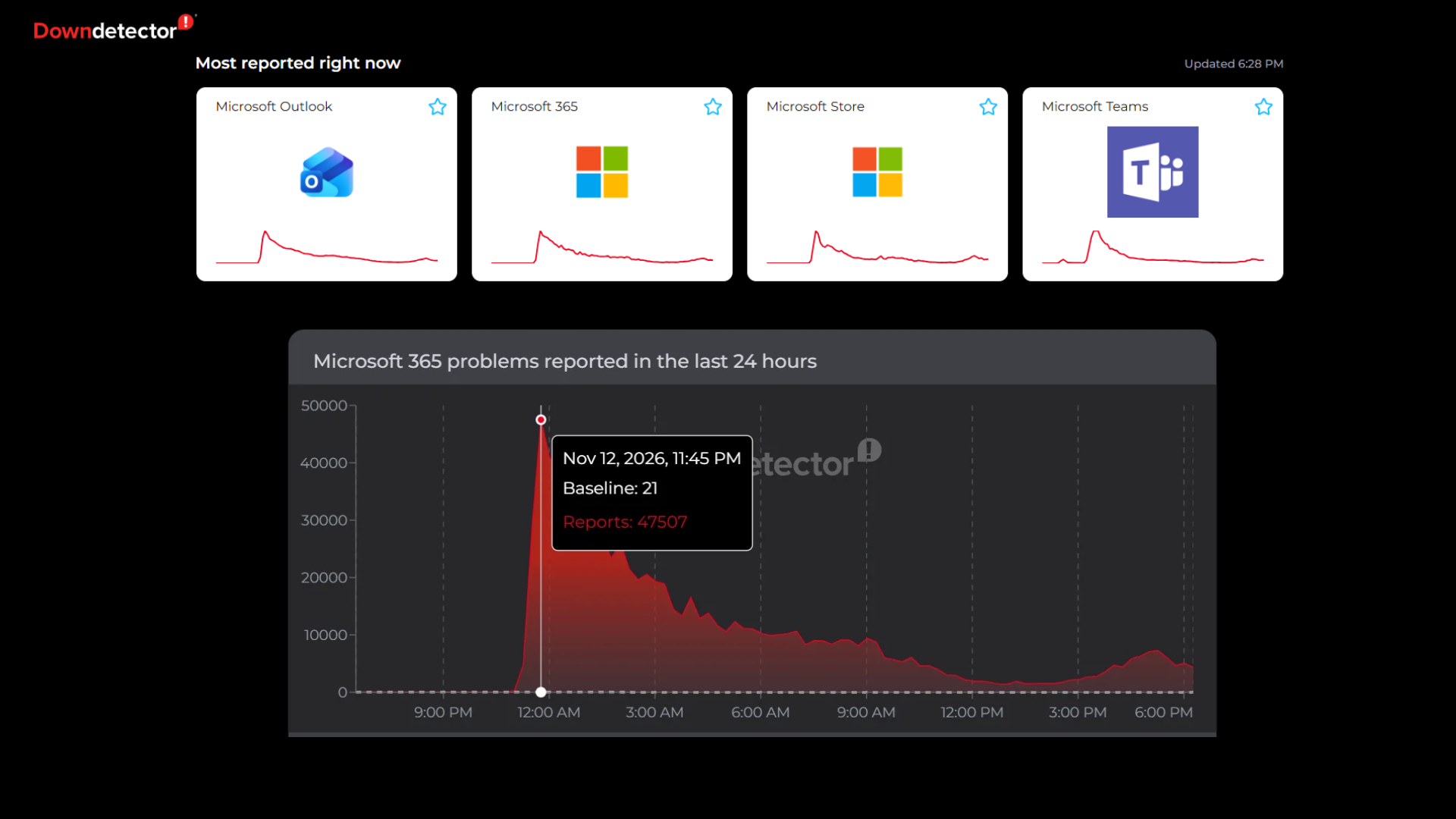
Of course, the outage doesn’t prove Slava right about Microsoft’s priorities. But it shows how, at this scale, a bug from one upgrade can be hidden until another change wakes it up, while millions wait for their email.
It didn’t help that the outage came days after Outlook’s spam rules wrongly blocked legitimate emails for days. Ironically, while Outlook was down, Microsoft Learn’s X account asked people for AI tips, and the top reply told Microsoft to make sure its product doesn’t fail.
Several Microsoft employees agree the company fixes what its biggest customers pay for
Slava’s thread is far from a hit piece. Most of it is praise for a company that can mobilize over 200,000 people in two weeks once leadership makes a call. After the Storm-0558 and Midnight Blizzard hacks, he says Microsoft tied every engineer’s pay to security, and within days, everyone was shipping security fixes. He also admits Microsoft waited too long.
In a May 2024 memo about prioritizing security above all else, Satya Nadella told employees that if security clashes with another priority, “your answer is clear: Do security.” Publicly, though, Microsoft only tied senior leadership pay to security, while Slava says it reached every engineer.

Anant Goel, who fine-tuned LLMs at Microsoft and now works at Zed, saw this outside Azure too. When leadership decided in 2023 that every Office app would get Copilot, his org had under two weeks to ship the first internal versions. And when he built an ML feature for Edge at a hackathon, a leader told him anything with “no path to generate >$1B/yr” wasn’t a good use of the org’s time.
Goel also agreed with Slava’s most quoted line, that Teams is less polished than Slack because Microsoft “doesn’t care one iota about polish. It cares about winning,” even though many engineers he worked with cared deeply.
Not everyone inside Microsoft sees it that way. Favour Adeniyi, a Microsoft designer on Azure, said her team works hard to simplify Azure’s experience, though features are prioritized by business goals. Marlene Mhangami, who works on developer experience at GitHub and Microsoft, said the thread resonated with her, but “Disagree on the taste comment he made.” Filip Mares, a forward deployed engineer at Microsoft, said it explains why he’s still at the company.
Slava also praised Microsoft’s lifers, like a storage engineer who fixed an IO issue in about a minute and turned out to have built async IO support in Windows NT. Yet he admits Microsoft has been trying to shed these people, including through a voluntary retirement program in May. In October, it offered voluntary buyouts to around 60,000 employees.
Slava’s full post is a must-read if you want to know the “fascinating perspective from inside the belly of the beast”, that is, Microsoft
Anyway, the fact is that Microsoft knows about the rough edges, and according to several of its employees, most of them just aren’t expensive enough to fix. If you look at how the September update for Windows 11 finally brought back the movable taskbar even after they insisted for several years that it was too hard a job, it just shows Microsoft can fix long-standing complaints when the pressure is high enough. And you can bet that we’ll keep it high from our end.
But for Microsoft’s unfortunate customers who are not in the Fortune 500, maybe the trick is to become Walmart!