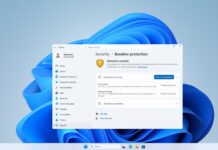
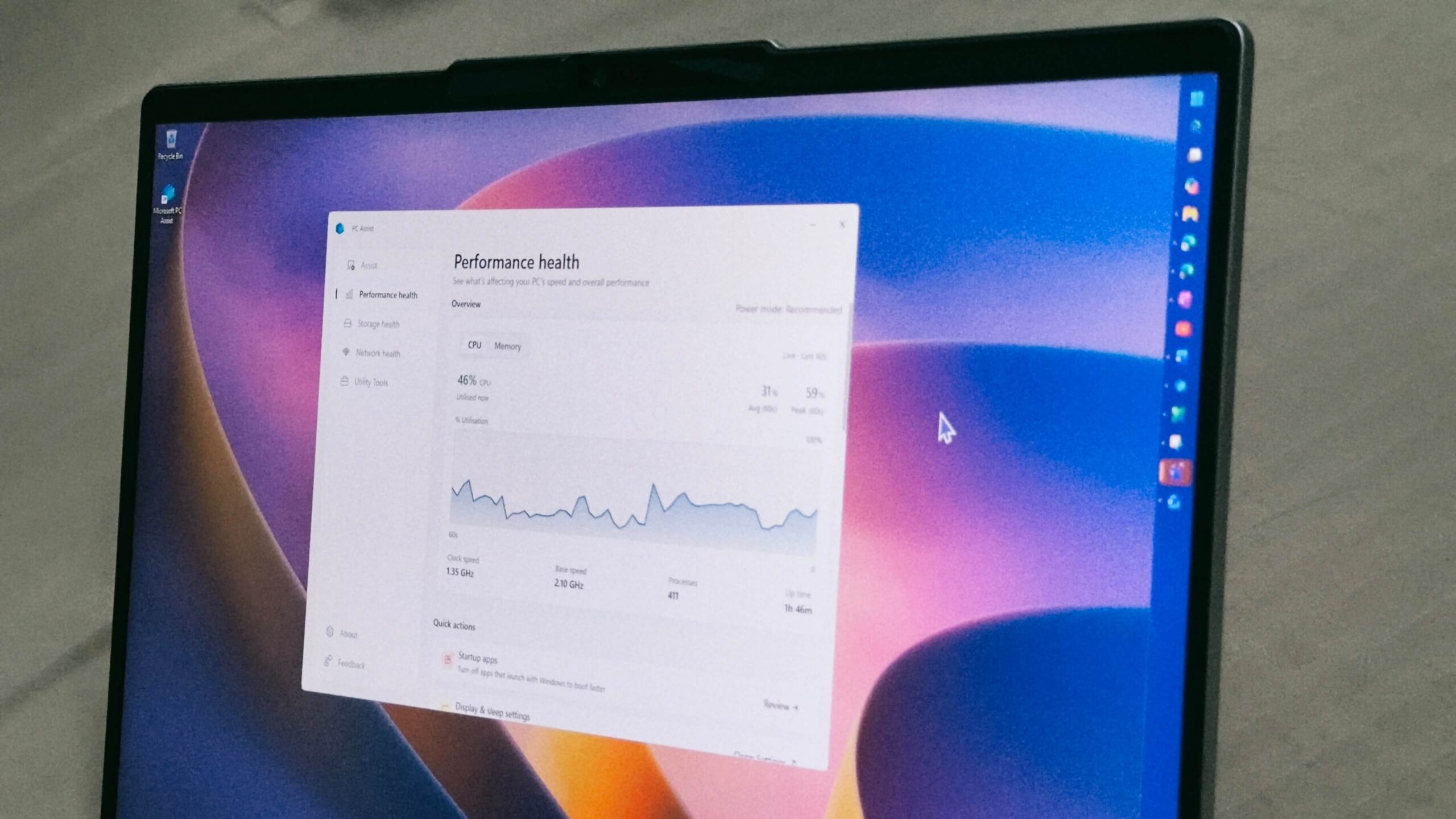
Microsoft has released PC Assist, an optional Windows app that promises to troubleshoot common problems, track your PC’s performance, storage and network usage, and bundle a few everyday tools. Windows Latest tested PC Assist version 0.4.4.0, and while its Performance, Storage and Network dashboards are pretty good, its troubleshooters open the Get Help app, and its tools shamelessly open Bing in your browser.
On its landing page, Microsoft says PC Assist lets you “Get guided assistance for your Windows PC.” The fine print under the Download button also says you’ll “receive in-app notifications with promotional offers from Microsoft” after you install it.
Microsoft already has Settings, Task Manager, Get Help, and my personal favourite, the PC Manager app, so why PC Assist? I installed the app, checked its features, and I understand why they made this.
Microsoft’s PC Assist installer asks to make Bing your default search engine
PC Assist is a separate, optional download from Microsoft’s website, and the installer I downloaded, PCAssistInstaller_en_v0.4.4.0.exe, was about 68.8MB.
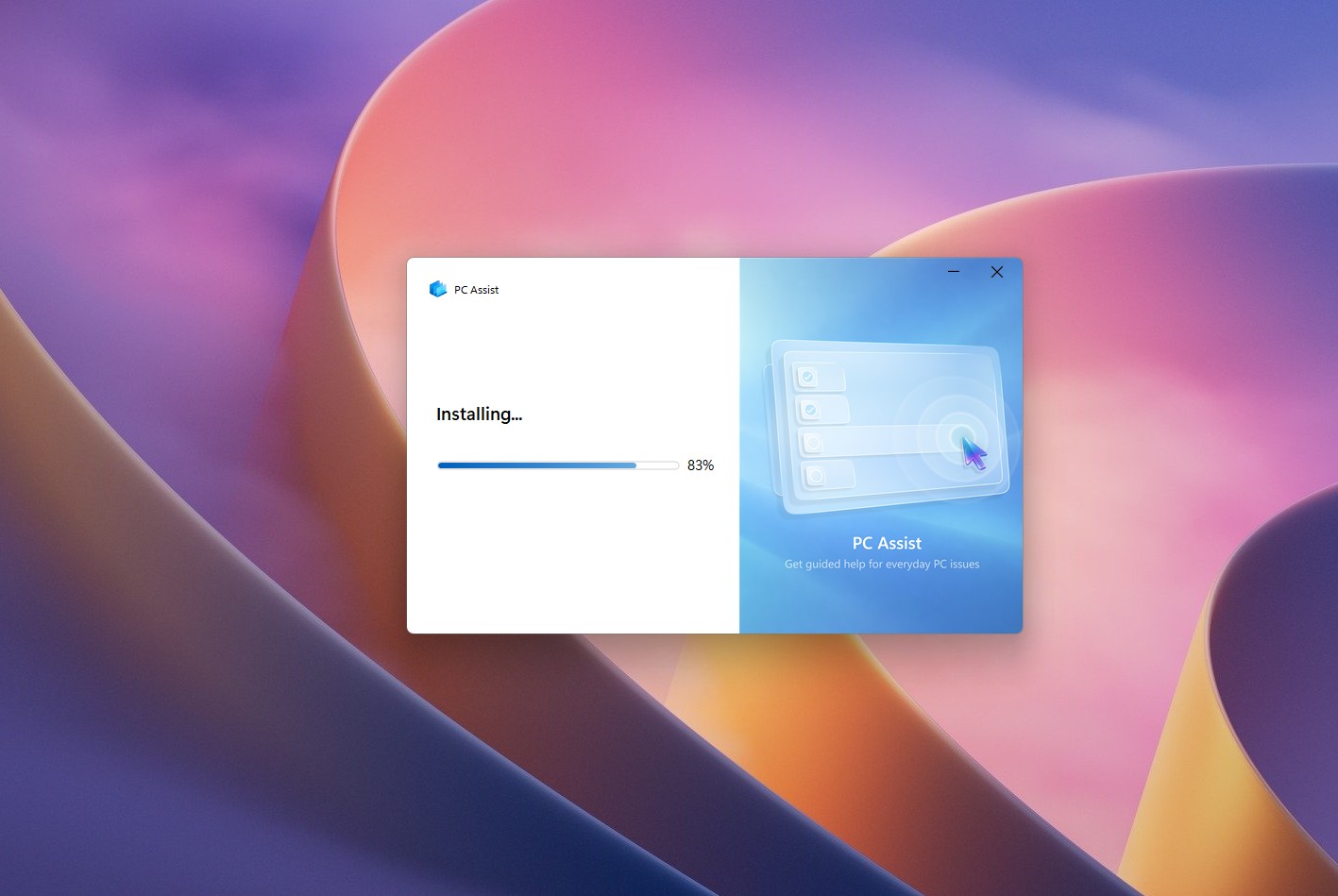
During setup, I noticed a toggle to make Bing the default homepage and search engine in multiple browsers on my PC, which is shady, to say the least. Microsoft doesn’t hide it, though, as its download page warns that you might be asked to “set Bing as your default homepage and search engine in your browser.” The toggle is set to on by default.
If this sounds familiar, it’s because, earlier this year, Microsoft built a dedicated app that pushes Bing into Chrome, Firefox and Brave and we tested that too, and was obviously disappointed. PC Assist is a different app, but the habit hasn’t changed.
Then, PCAssist.UI.exe refused to launch, saying, “You must install or update .NET to run this application,” as it needs Microsoft.NETCore.App version 10.0.0 (x64). So, I installed the .NET 10 Desktop Runtime and ran PC Assist again.
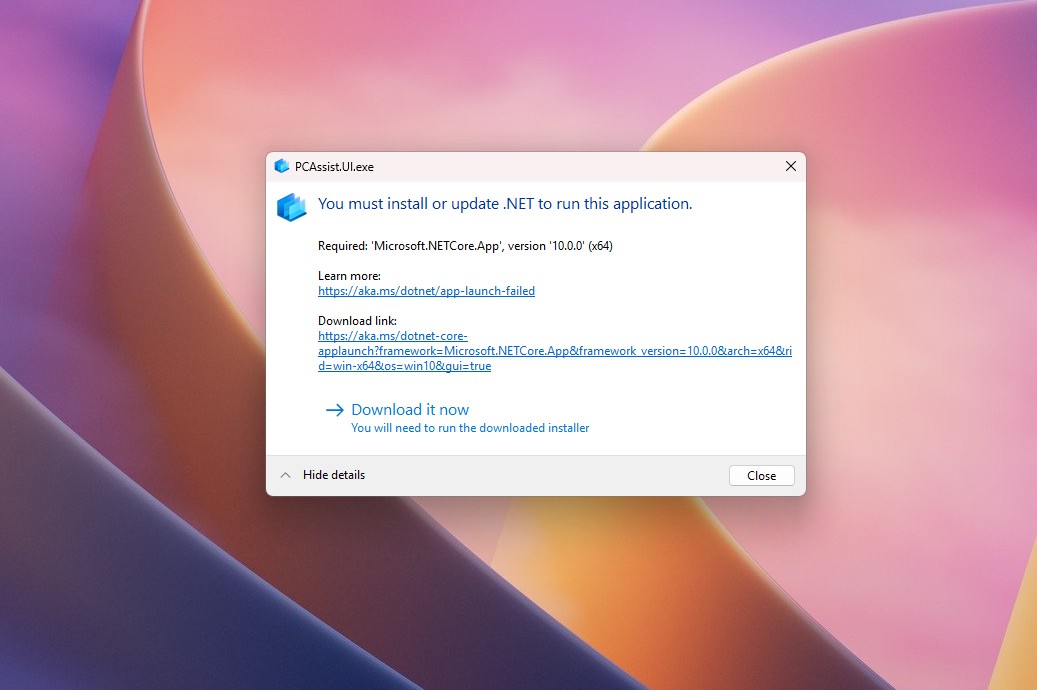
The .NET Desktop Runtime lets apps built with .NET run on Windows, so it’s a normal requirement. Still, most people downloading a “PC help” app won’t know what .NET is.
PC Assist’s troubleshooters just open the Get Help app
PC Assist opened in light mode, even though my Windows 11 PC uses dark mode, and I couldn’t find a dark mode option anywhere, which is both funny and weird. There’s no maximize button, and dragging the edges doesn’t resize the window, which are the bare minimum for a Windows utility in 2026, but it could be intentional, like the PC Manager app (more on it later).
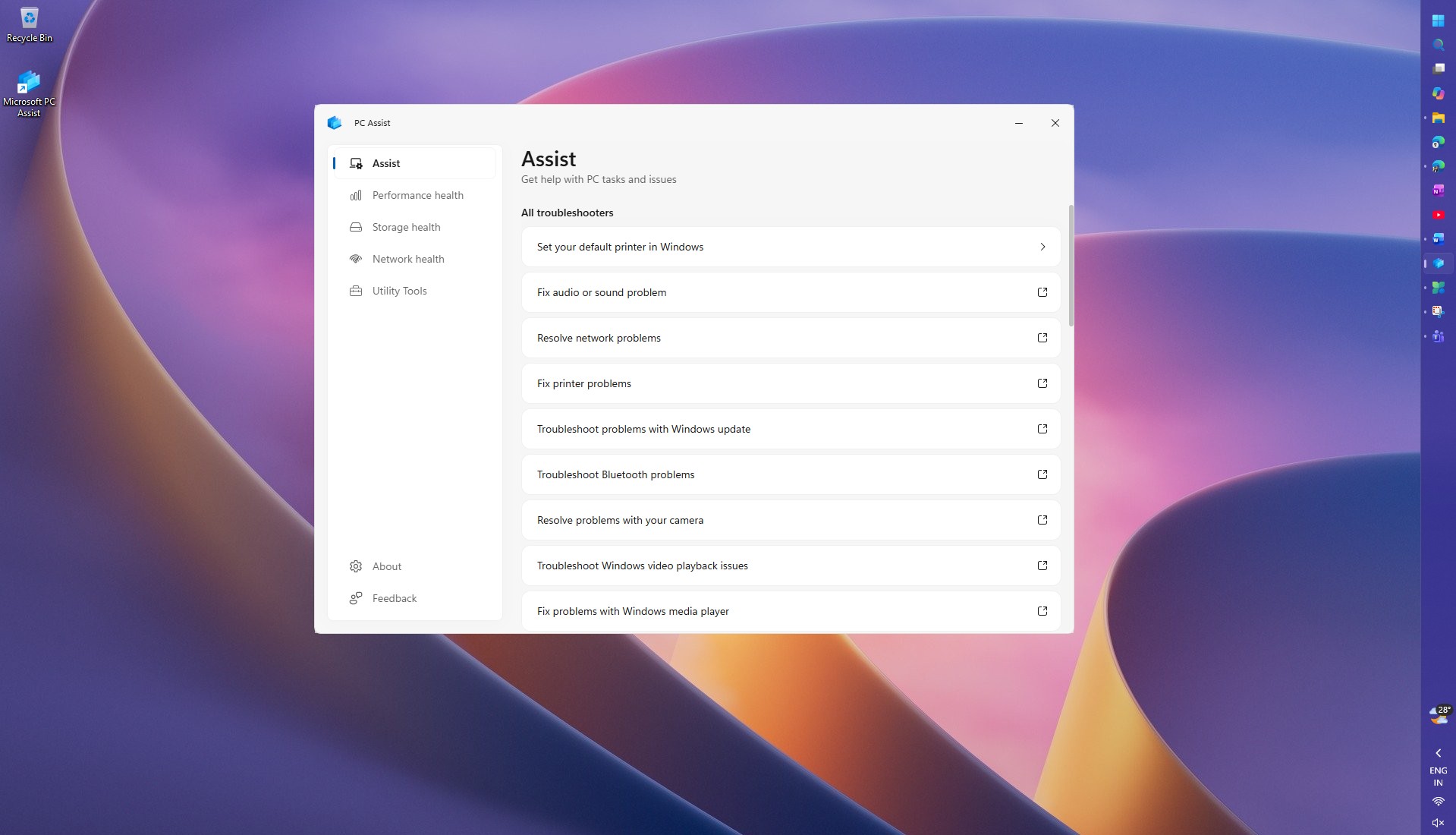
The app has five sections: Assist, Performance health, Storage health, Network health and Utility Tools. Assist is the first one, and it lists troubleshooters like Fix audio or sound problems, Resolve network problems, Fix printer problems, and Troubleshoot Bluetooth problems. Apart from the default printer option at the top, every item has an external link icon next to it.
I clicked the audio troubleshooter, and PC Assist showed a prompt saying, “This site is trying to open Get Help,” from https://pcassist.local. Clicking Open launched the Get Help app, which ran its audio troubleshooter.
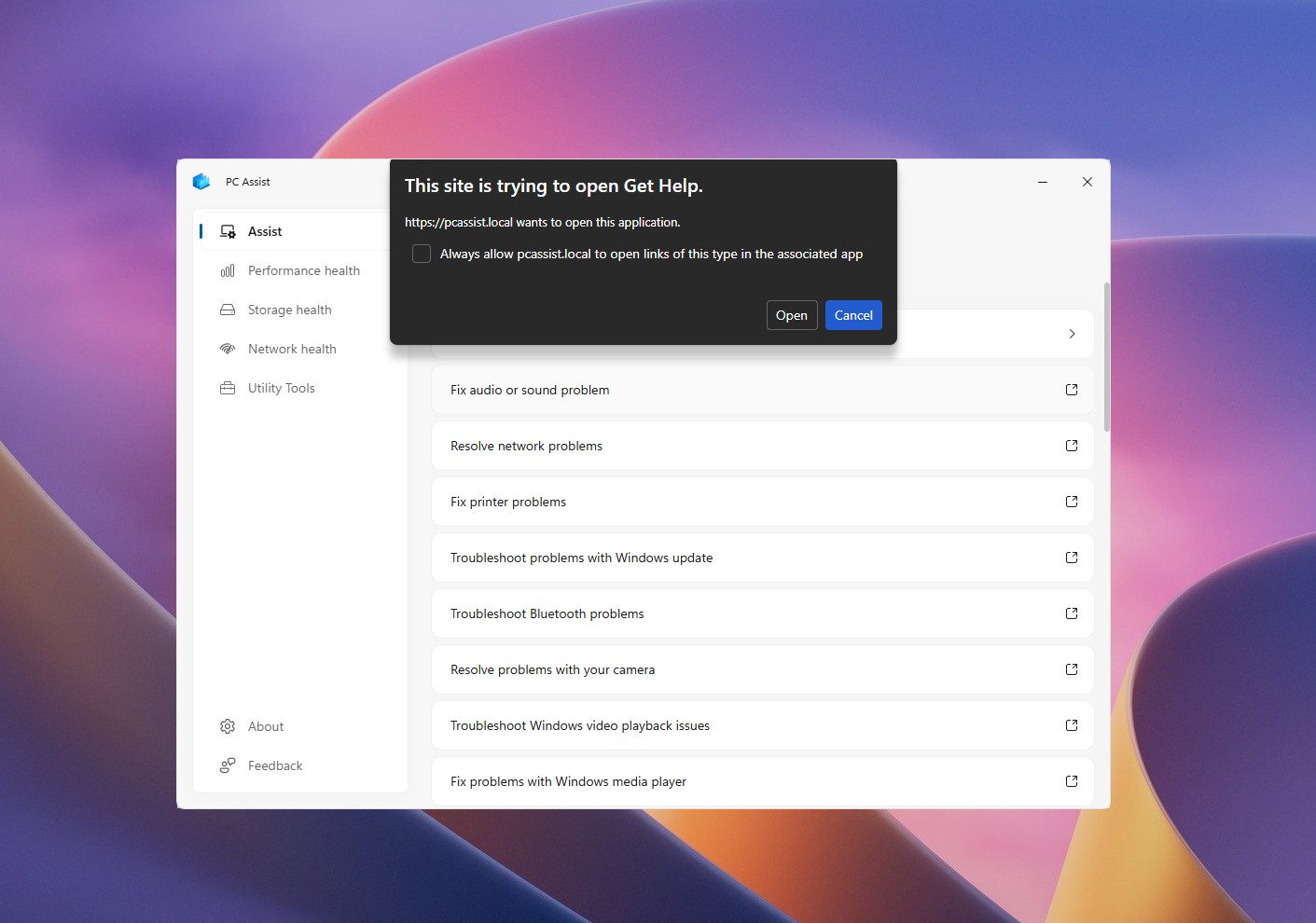
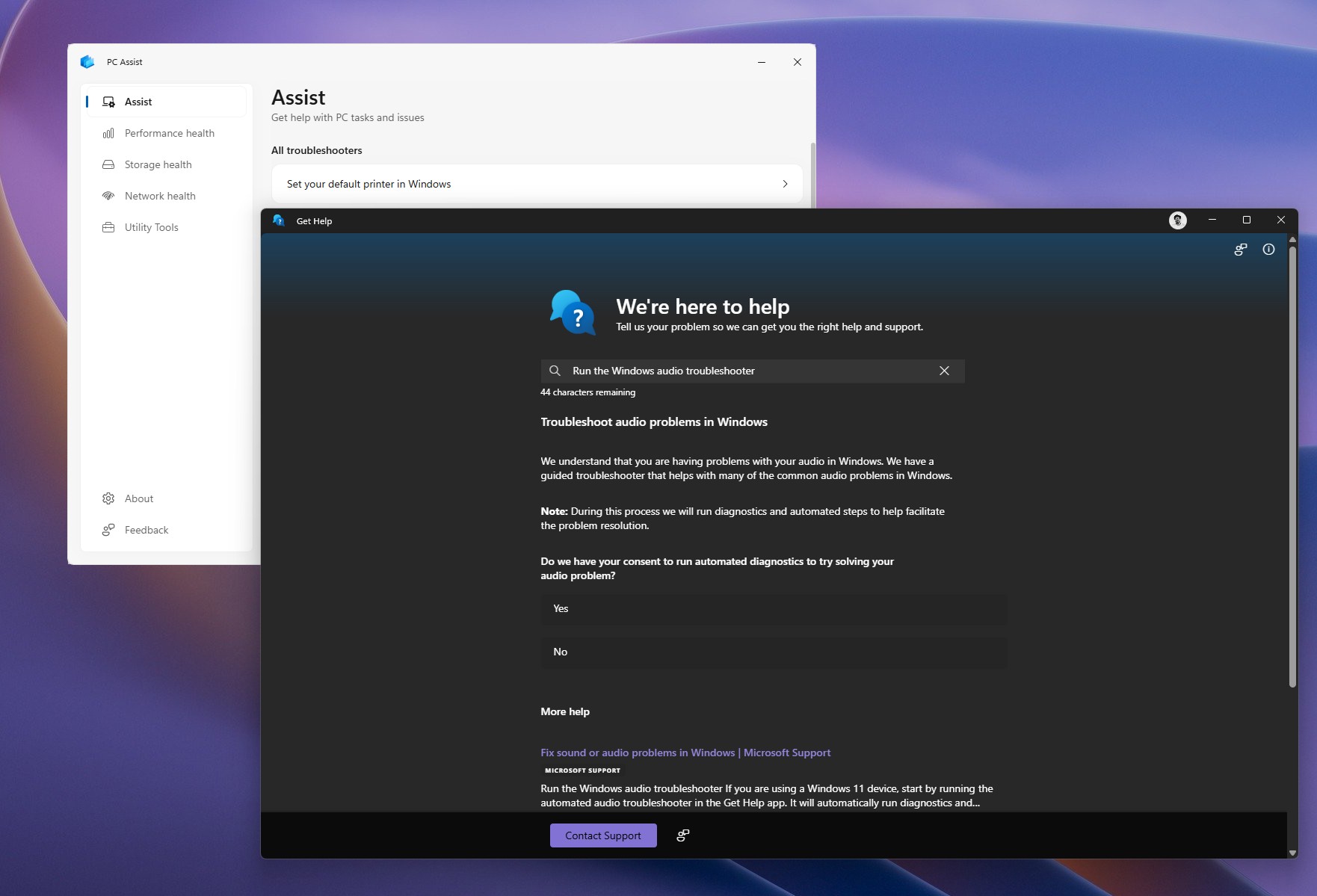
Every other troubleshooter on the list does this, too, so Assist is basically a launcher for Get Help, which is already built into Windows 11. If Get Help does the troubleshooting anyway, why make PC Assist at all?
Interestingly, Microsoft’s support page to set a default printer in Windows now suggests letting PC Assist do it for you, so Microsoft is clearly pushing the app.
Performance health and Storage health are the best parts of PC Assist
Performance health is where PC Assist shines, and it’s basically a friendlier Task Manager. A CPU and Memory toggle at the top switches between two live graphs of the last 60 seconds.
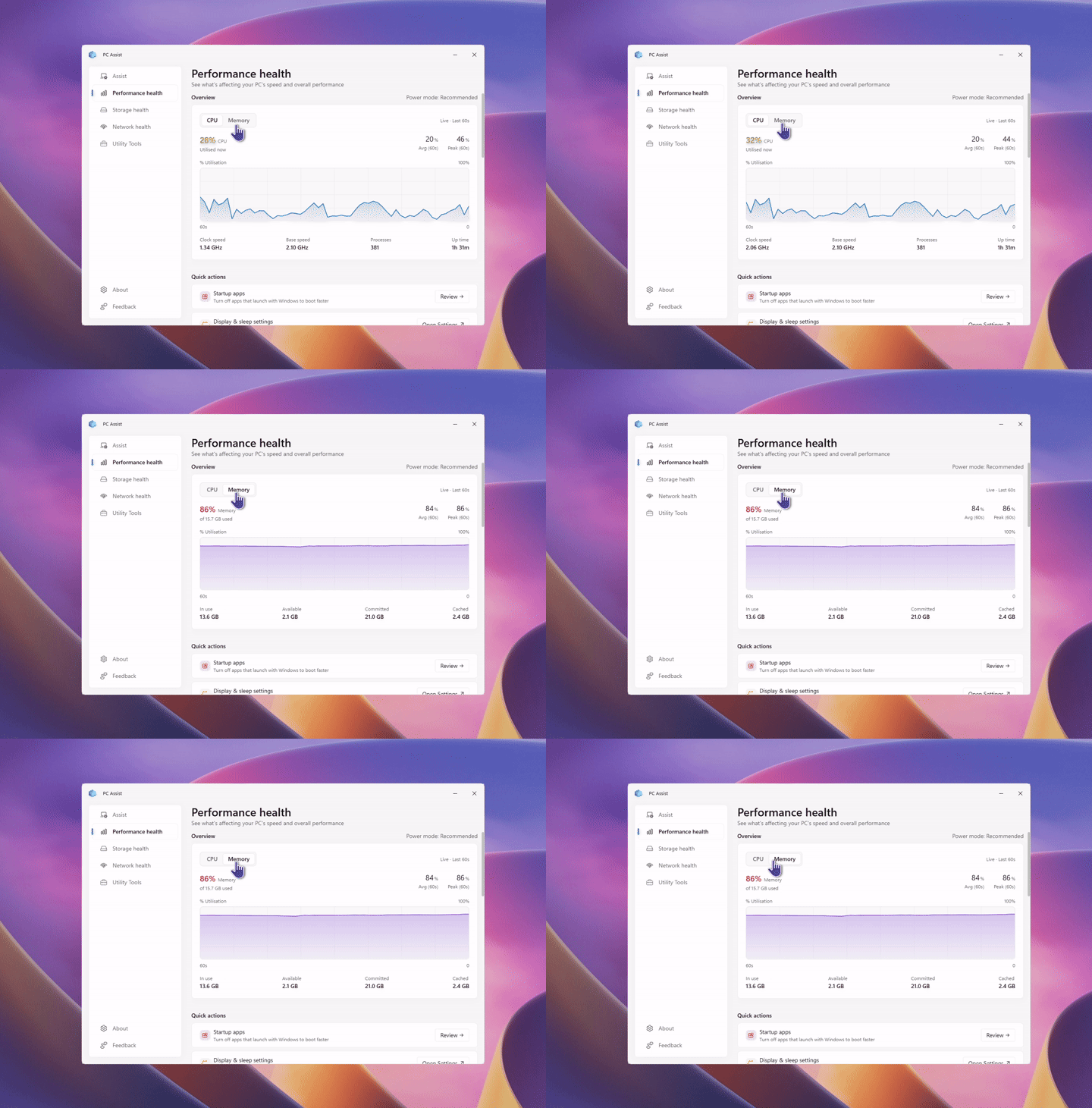
In CPU mode, I could see my laptop’s current, average and peak CPU use, along with clock speed, base speed, the number of running processes and uptime. Switching to Memory showed 89% of my 15.7GB RAM in use, split into In use, Available, Committed and Cached. Yes, Edge and my usual pile of tabs are to blame.
There’s also a Power mode indicator and three quick actions. Startup apps lets you review apps that launch with Windows, Display & sleep settings opens the matching Settings page, and All processes opens Task Manager.
The Top resource consumers list is my favourite part. It shows the apps hogging your CPU and RAM over the last 60 seconds, with their peak CPU, memory use and a button to close them.
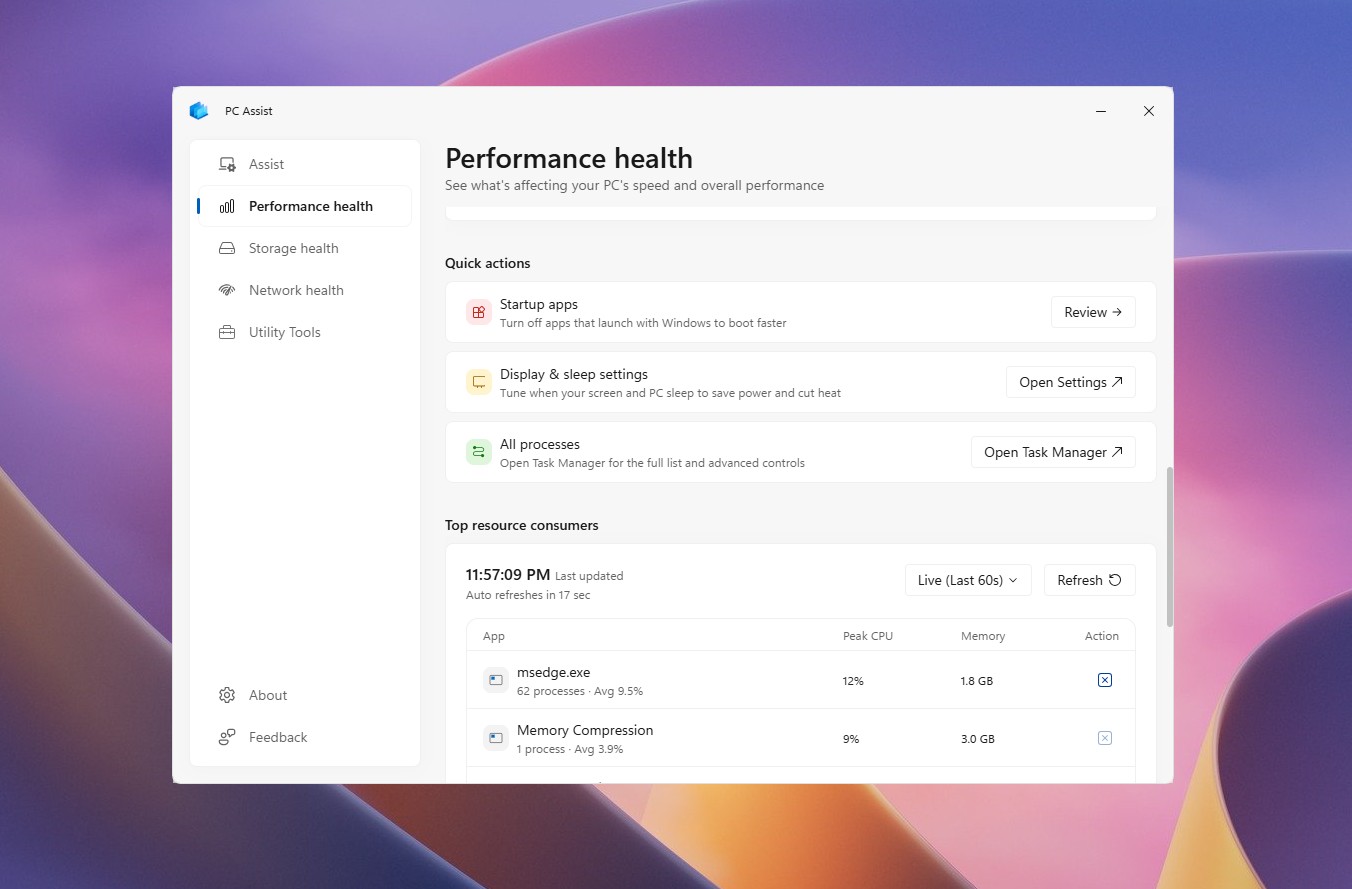
All of this usually takes a few clicks across Settings and Task Manager, so having it on one clean page is handy. It’d make a great desktop widget, too, but PC Assist doesn’t have one.
Storage health loaded faster than I expected, and it’s just as useful. It showed my 475GB drive as Healthy, with 418GB used and 56.3GB free. Installed apps took 92.9GB, System & reserved 55GB, Temporary files 35.7GB (I know, I know) and Pictures 12.2GB, with more categories a click away.
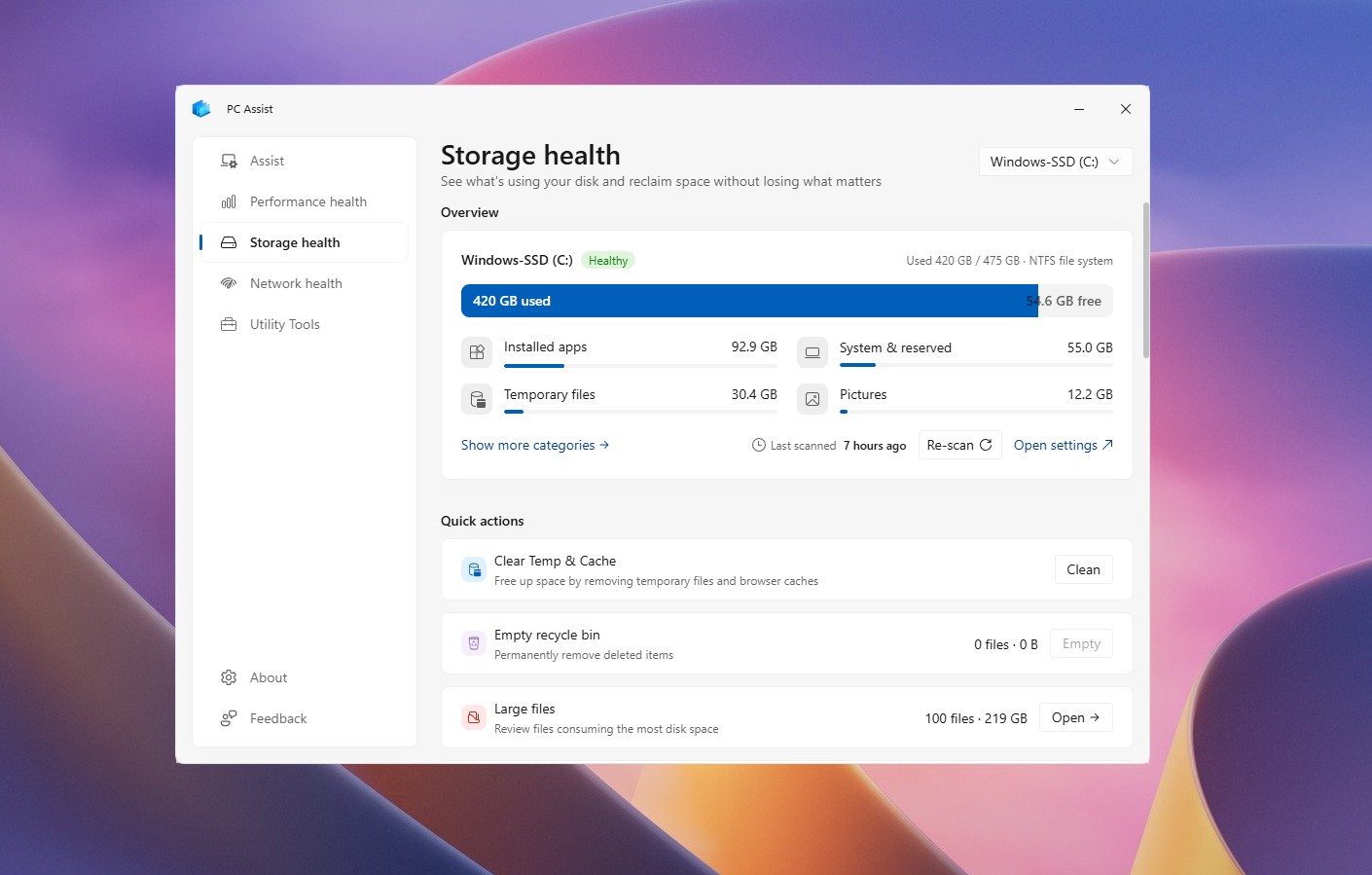
The quick actions are where Storage health earns its place. PC Assist found 100 large files using 219GB, 478 duplicate files taking 718MB and 42 rarely used apps taking 11.4GB, each with an Open button to review them. You also get Clear Temp & Cache, Empty recycle bin, Old downloads and a Storage Sense toggle.
Windows 11’s Storage settings spread most of these across different pages, and they don’t include a duplicate file finder.
Network health is impressive, but Utility Tools is a Bing launcher
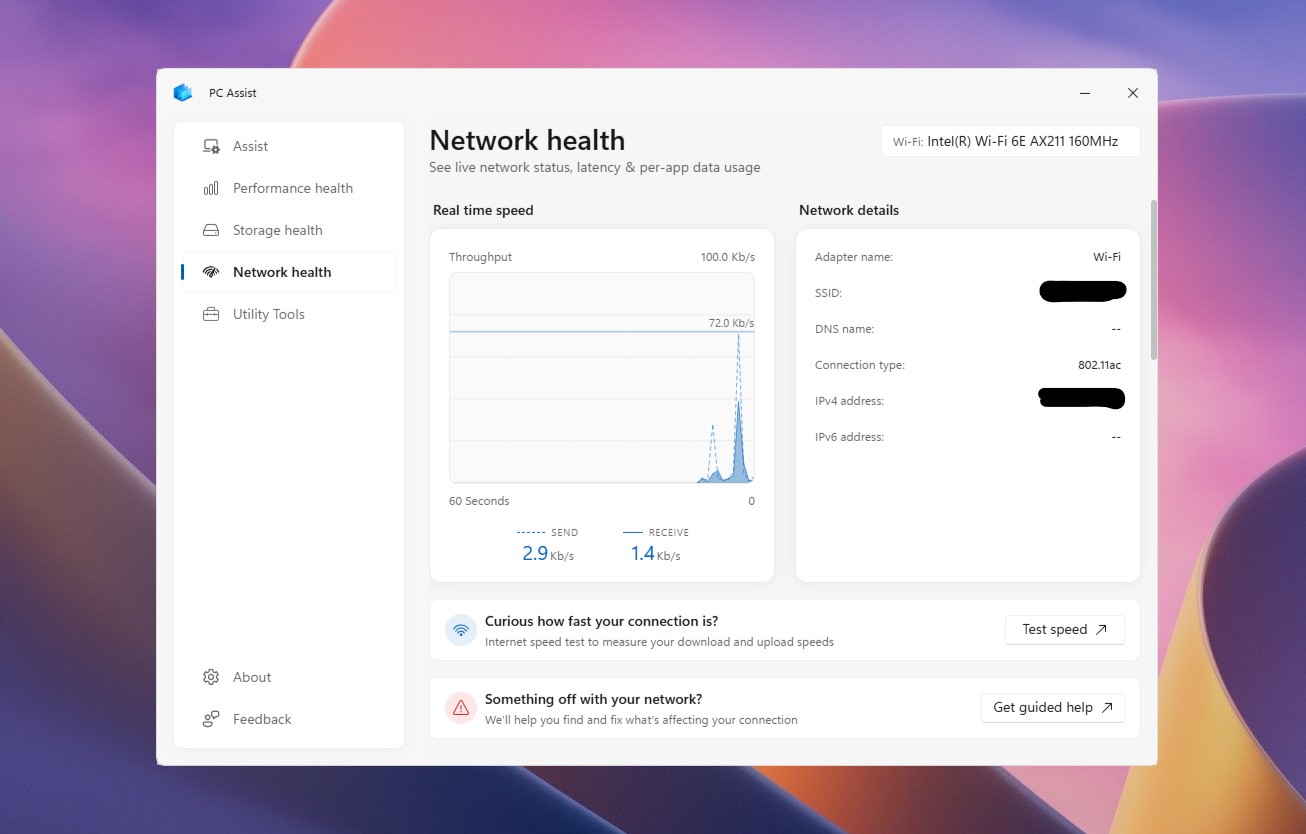
Network health is the other highlight. It shows a real-time throughput graph with send and receive speeds, along with network details like the adapter, SSID, DNS, connection type, and IP addresses.
Below that, Past usage shows how much data each app used over the last 30 days, with a Set data limit button. Chrome used 113.65GB of my 325.87GB, followed by Edge at 67.80GB. Live usage shows which apps are using your bandwidth right now, and Lenovo’s Smart Connect, which streams my Motorola phone to my laptop, was at 80%.
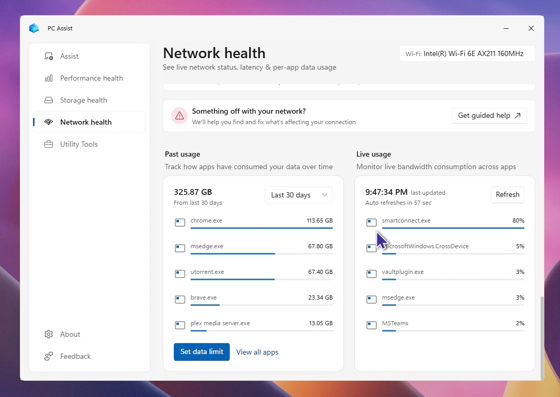
In Windows 11, past usage is buried in Settings > Network & internet > Advanced network settings, while live usage needs Task Manager. PC Assist puts both on one page, which is good.
But there’s a catch. The Test speed button doesn’t run a speed test inside PC Assist. It opens Bing’s speed test in your browser, and that’s where everything starts going downhill.
Utility Tools has ten tools, including Translator, Currency converter, Weather, Image creator, Video creator, and Internet speed test. Clicking any of them opens its Bing version in your browser.
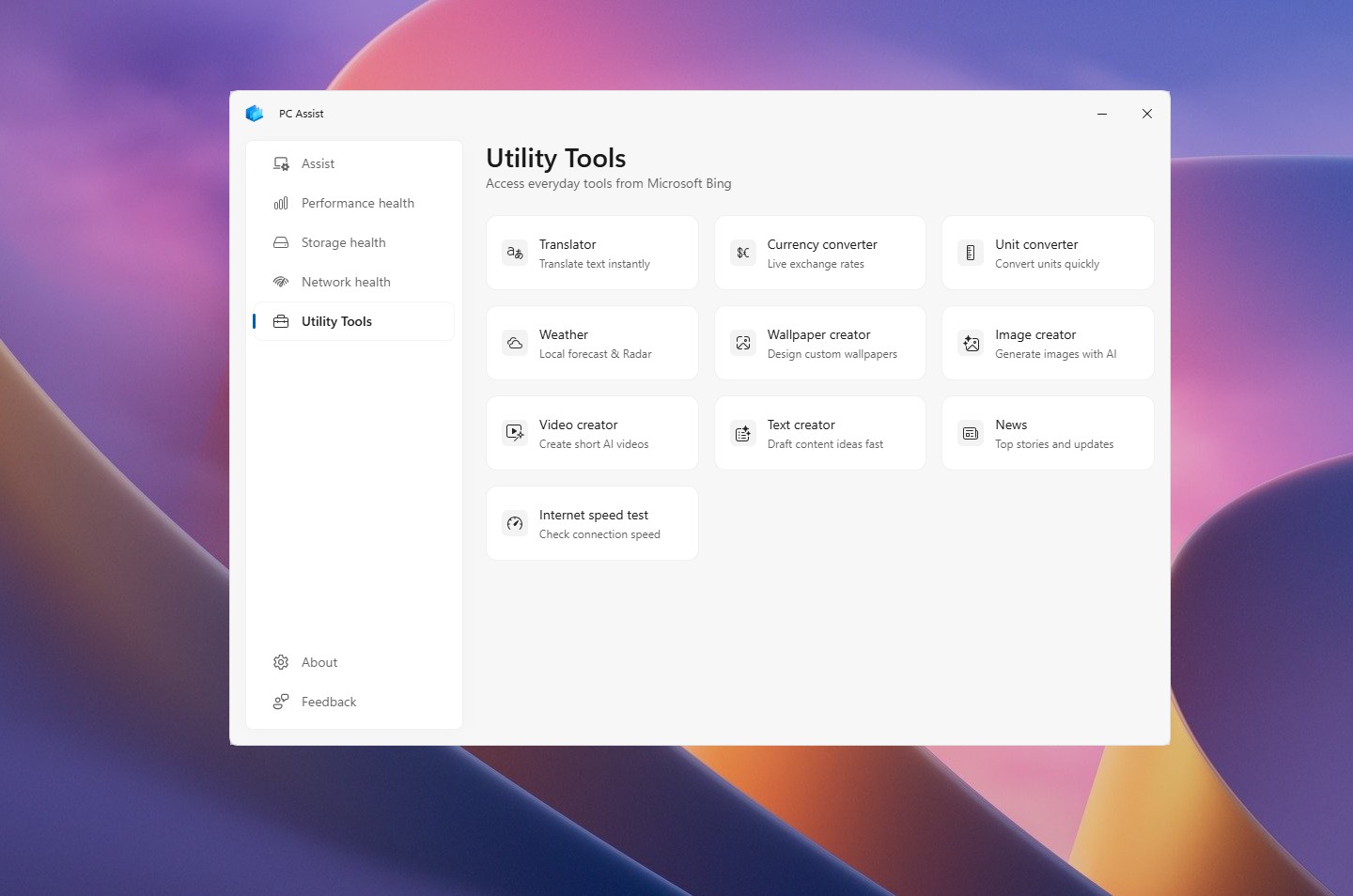
Yes, the page says “Access everyday tools from Microsoft Bing,” so Microsoft isn’t hiding their audacity. My problem is that you have to leave the app to use them, which turns Utility Tools into a list of bookmarks. You don’t need an app to bookmark Bing!
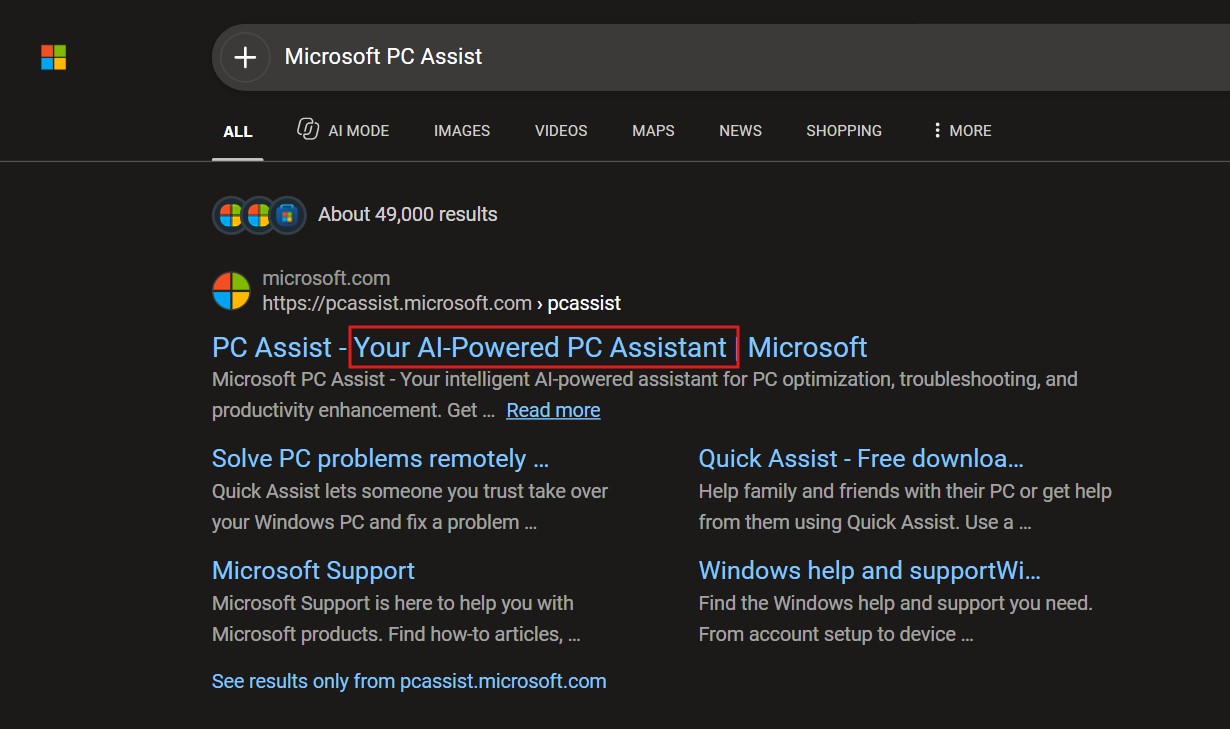
Then there’s the AI claim. Search for PC Assist on Bing, and the result is titled “PC Assist – Your AI-Powered PC Assistant.” But I couldn’t find any AI feature inside the app. The only AI on offer is Bing’s image, video and text creators in a browser tab. Unless the AI-powered part is how the app was made (I’m kidding… mostly).
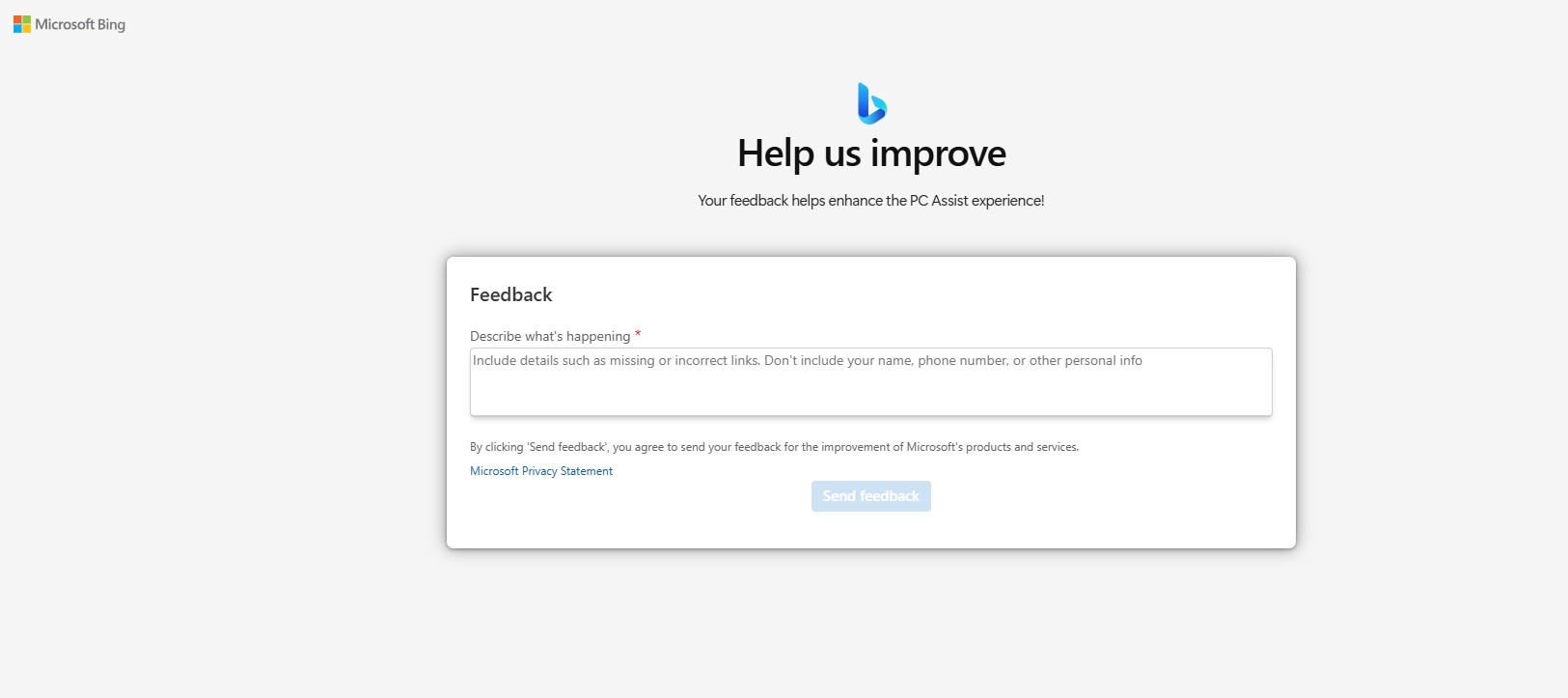
Clicking Feedback in PC Assist opened a Microsoft Bing-branded “Help us improve” page. It’s a strong Bing connection, although it doesn’t tell us which team at Microsoft built the app, but if I’m to guess, this might be the Bing team’s doing.
PC Assist is not a replacement for Microsoft’s PC Manager
Microsoft already has a PC maintenance app, and it’s miles ahead of PC Assist. PC Manager became widely available via the Microsoft Store in 2024, and it cleans junk files, frees up memory, manages processes and startup apps, finds large files, and follows your Windows theme. It also has a floating toolbar that shows your internet speed in real time. PC Manager is peak Microsoft in my books, and its UI is brilliant. I use it every day.
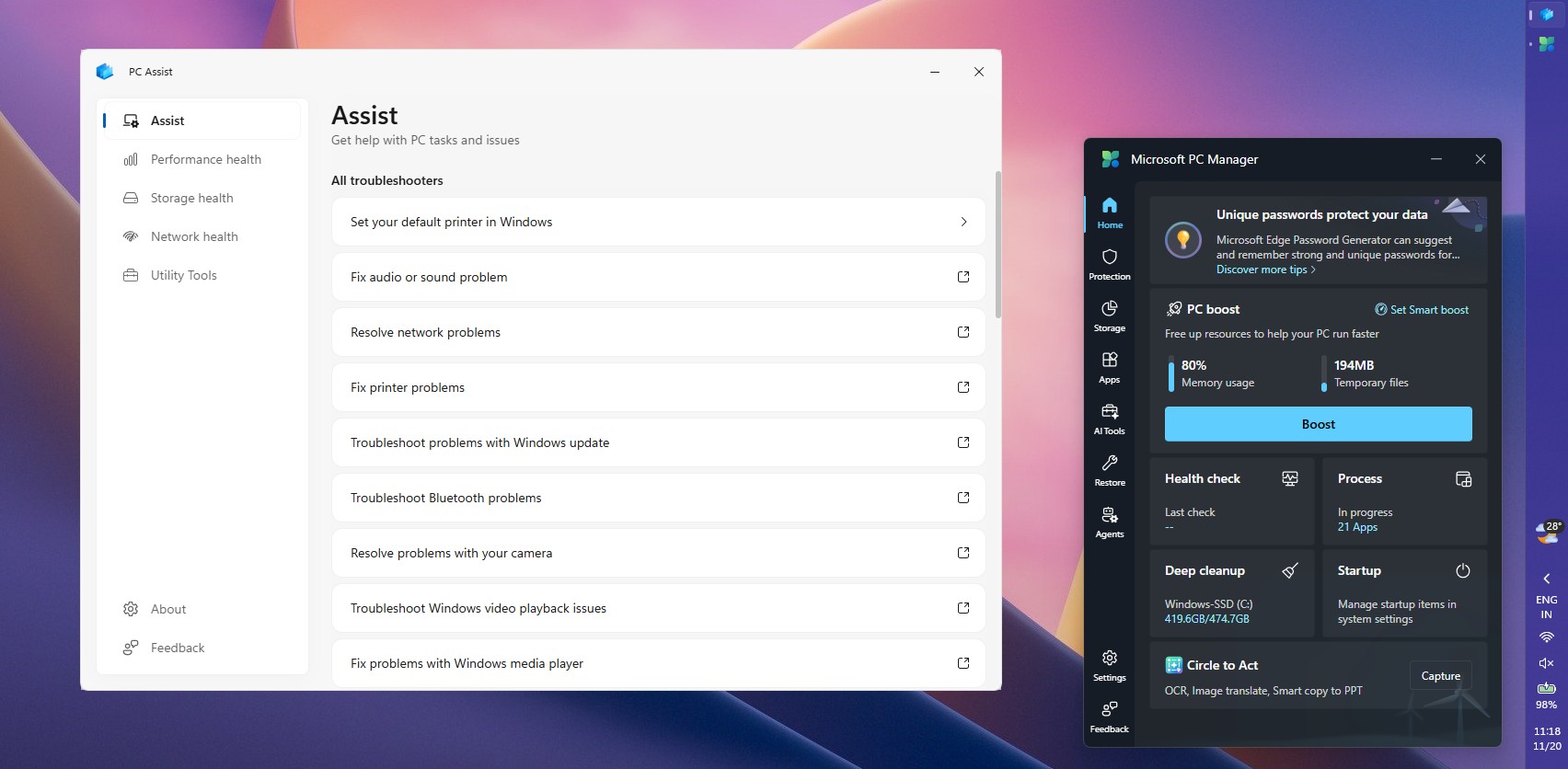
Of course, PC Manager isn’t perfect either. It has shown Microsoft 365 ads, and its toolbox opens a couple of Bing tools in Edge. But PC Manager does its core job inside the app, while PC Assist sends you elsewhere for most of what it advertises.
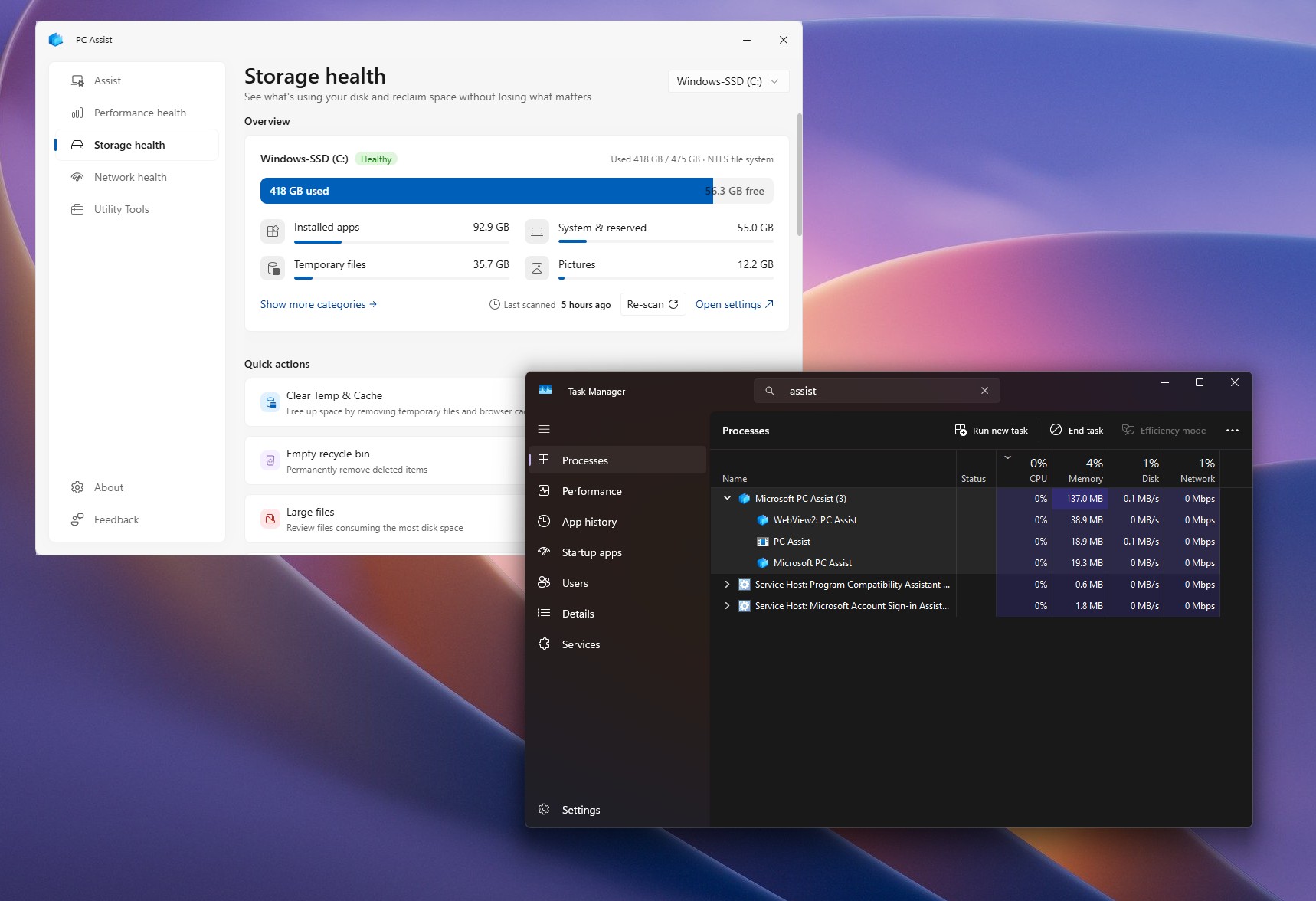
Out of curiosity, I checked Task Manager. PC Assist runs as a group of three processes: PC Assist, Microsoft PC Assist, and WebView2. PC Assist using 137MB of RAM in total. So, at least parts of PC Assist are web pages rendered with WebView2. Funnily enough, a mix of native and web parts is just like Windows 11.
Microsoft seems to have more time to build app shells than to finish the tools in it. PC Manager is what PC Assist should have been, and Microsoft could’ve added these dashboards to it instead of building another app that overlaps with Settings, Task Manager, and Get Help.
Microsoft needs to make PC Assist useful before making it another Bing promotion
PC Assist may have a semi-solid foundation, but when you do anything more than monitor your PC, it sends you to Get Help or Bing. If Microsoft is reading this, my feedback is simple: build the troubleshooters and tools into the app, add dark mode and a resizable window, and explain what’s AI-powered about it. And while you’re at it, remove that WebView2 part as well. It needs to be pure WinUI, as that’s what Microsoft is preaching.
Microsoft doesn’t seem to even vaguely understand the psychology here. Pushing Bing to people at every click won’t make them choose the search engine. It actually does the opposite. If PC Assist worked brilliantly, people would trust Microsoft’s software again, and they’d pick Bing and Edge on their own because they want to. What’s so difficult to understand?
On one side, Microsoft is killing To Do, which is universally loved, based on the X replies from the last two days, as we were the first ones to spot it. And on the other side, the company is making useless apps like this with the only purpose being to promote Bing. Does Microsoft hate its customers?