









No, Linux desktop market share has not crossed 10% in North America, and Windows is not suddenly losing millions of users. 2026 is not the year of Linux, for those who care. If anything, it’s the year the internet died, because the entire spike appears to be driven by AI bots.
Almost every month, we have a viral story claiming that Windows is losing market share and Linux is eating it for breakfast. These claims always link to the same source, StatCounter, which is misinterpreted by most people.
For example, this week, one of the most upvoted posts on Reddit’s Linux community and even Hacker News claims that “Linux desktop market share has hit over 10% in North America.” The original poster dropped a huge screenshot that shows Linux winning after years of struggle, but the screenshot also points to the obvious problem with the numbers:

The data shows Windows at 57.54%, ChromeOS at 2.06%, Linux at 10.65%, OS X at 21.14%, and macOS at 8.6%. This is where I stopped reading. We’re looking at OS X, which was replaced by macOS in 2016, at 21.14%, while macOS itself sits at 8.6%.
Even if you consider OS X and macOS separate operating systems, it does not make sense for the decades-old ‘OS X’ to have more users than macOS.
StatCounter does not track actual Windows or Linux users
But is it really StatCounter’s fault? Well, no. It was never supposed to be treated as the baseline for desktop or mobile market share. For those unaware, StatCounter is an analytics platform for web publishers and developers, and it allows webmasters to monitor traffic to their sites if they prefer not to use Google Analytics or other options.
Unlike Google Analytics, StatCounter regularly publishes public “market share” reports, with the final numbers usually appearing around the end of each month. It also publishes its methodology.
“Our stats are based on over 3 billion page views per month to over 1 million global websites – we are not aware of any other publicly available service providing market share stats that has a bigger sample size on which they base their information. We base our stats on page views (and not unique visitors) – we feel that this gives the fairest approximation of internet usage.”
As you can see, StatCounter counts page views, not individual people or actual PCs. It simply cannot and would not collect such sensitive data.
In other words, if Linux-based agents or bots suddenly visited sites that use StatCounter’s tracking code, Linux’s number could rise, and Windows would lose market share because the numbers are measured on a 100% scale. However, it does not mean people have replaced Windows on their PCs.
Only Microsoft or OEM partners can tell you with the highest accuracy how many people use Windows now versus five years ago. According to Microsoft, Windows 11 runs on 1.6 billion PCs, up from the 1.3 billion Windows 10 PCs it reported in 2021.
StatCounter has reported similar anomalies before
In July 2026, I reported that Windows market share did not fall below 60% or lose 20 percentage points to Linux. That viral number was based on June 2026 market share data, and it was later corrected by StatCounter.
Not just that, but StatCounter once suggested that Windows 7 was gaining users while Windows 11 was declining, which encouraged publications to crank out stories calling Windows 11 a failure.
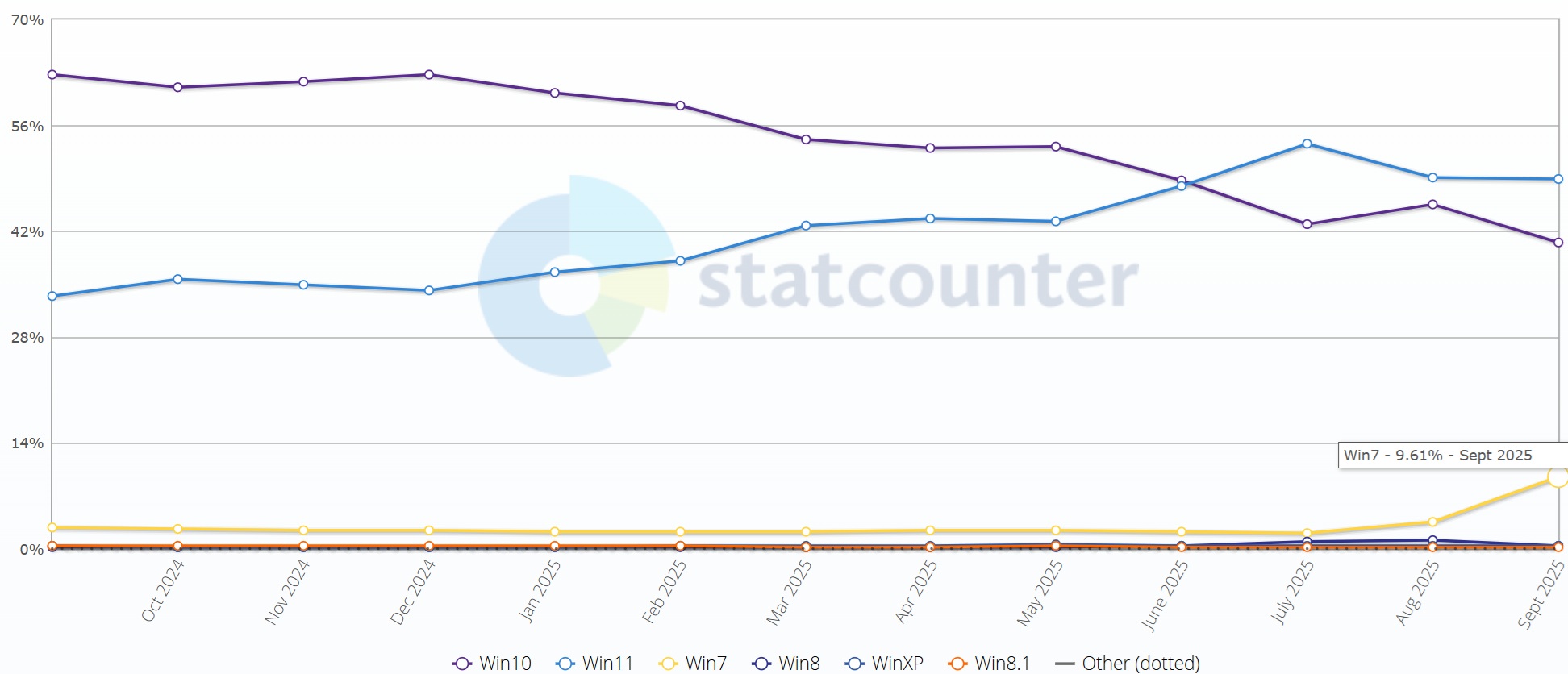
Granted, Windows 11 is not a perfect OS, and some preferred Windows 7 or even Windows 98 over it, but that doesn’t mean it’s losing users to a decades-old operating system.
In previous reports, Windows 8.1 has also jumped unexpectedly in certain regions, and those numbers were later corrected.
These problems are not just limited to operating systems, as the same thing happened with search engines. StatCounter previously reported that Google had lost roughly ten percentage points, and the internet called it the ChatGPT effect when it was, in fact, a reporting error. In reality, Google had one of its best quarters.
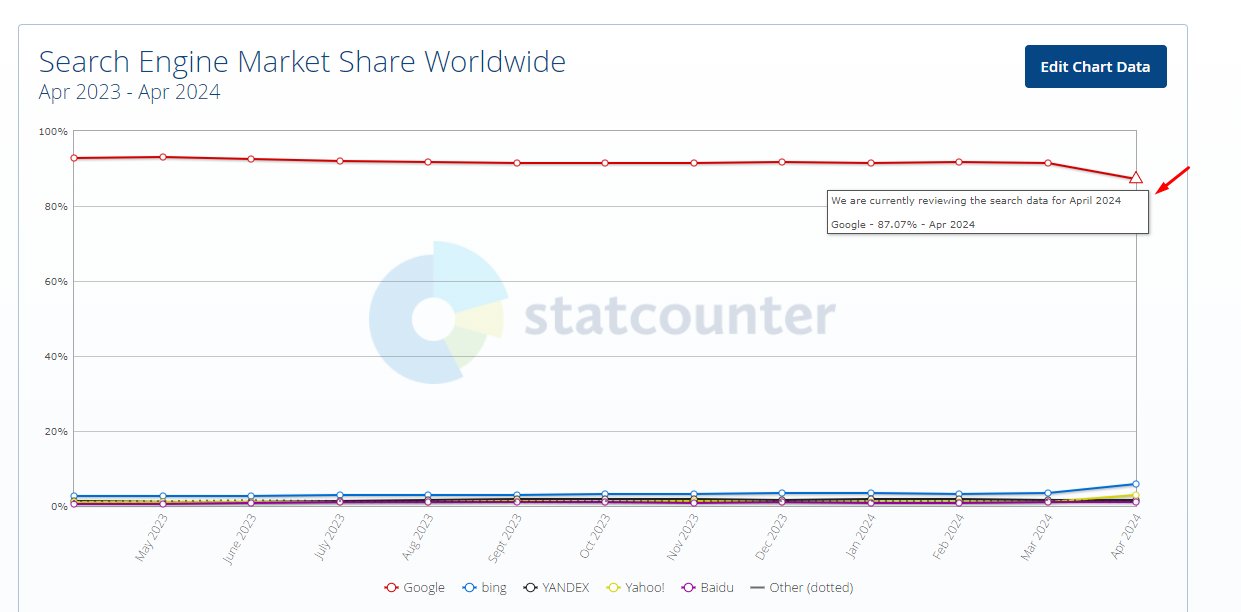
If you still believe the false numbers, you should ask yourself whether millions of people would realistically uninstall Windows 11, move back to Windows 7, and then reverse that decision a few weeks later. Or whether millions would suddenly abandon Google for ChatGPT and return almost immediately.
It doesn’t work like that, does it? And I don’t blame StatCounter for the misinformation being peddled by engagement baiters.
Cloudflare Radar also shows a Linux spike, but bots explain it
One alternative is Cloudflare Radar, which is based on data from Cloudflare, one of the largest internet security and DNS services. In addition to traffic breakdowns, it also provides a handy breakdown of bots and human activity, so you can compare it with Windows and Linux market share.
Some people also jumped to Cloudflare Radar to verify whether StatCounter was correct, and to their joy, Cloudflare also recorded a Linux spike around the same time as StatCounter. Now, we’re looking at a correlation, but does correlation mean there are no other factors involved? Of course not.
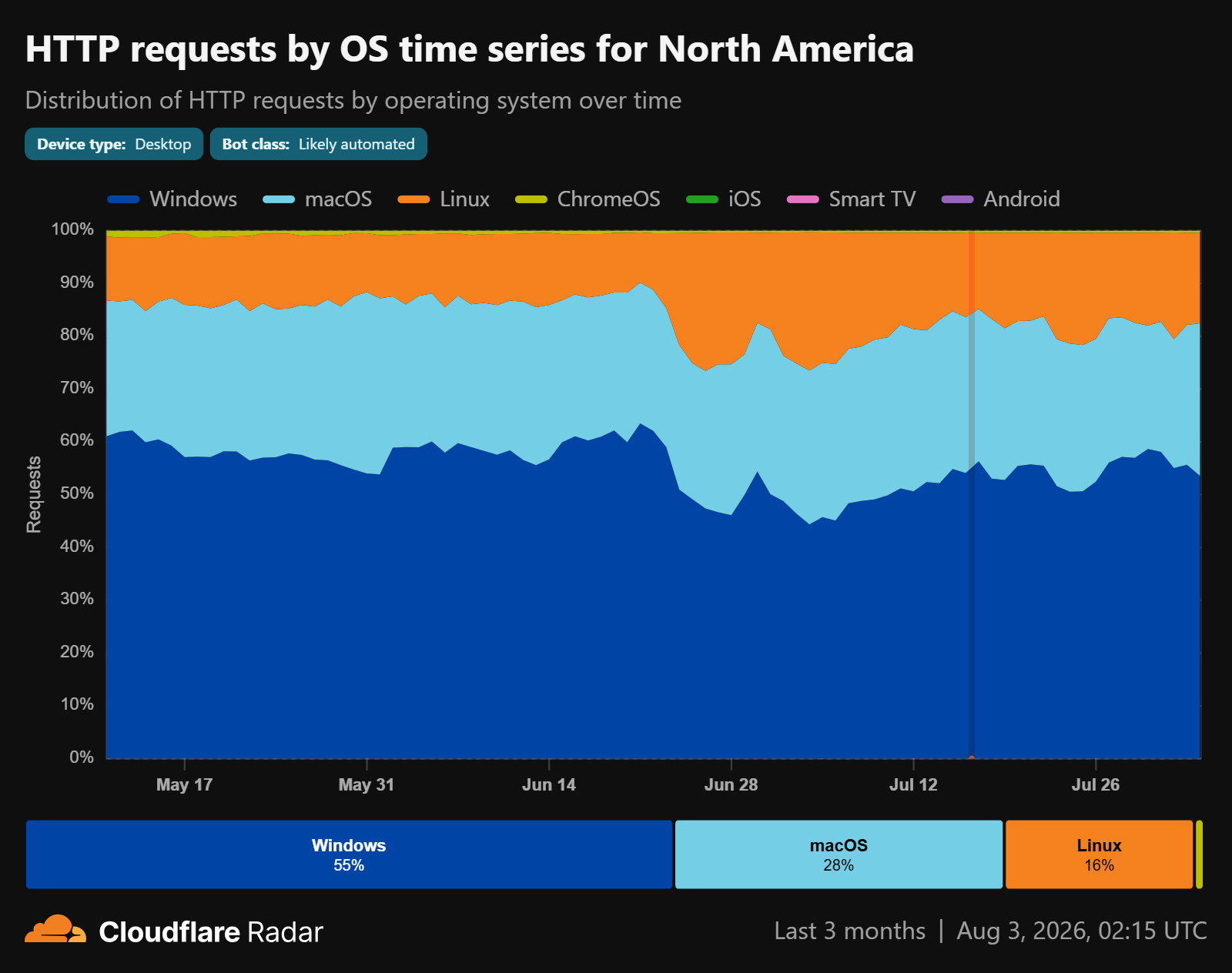
I looked up the data provided by Cloudflare for North America, and indeed, it shows a spike for Linux. According to Cloudflare Radar’s default data, Linux is at 16% market share, and Windows has dropped to just 55% from 65% last month. But I took a closer look and figured out that Cloudflare has the same problem as every internet company: BOTS!
The Linux surge collapses when you filter for human traffic
Unlike StatCounter, Cloudflare Radar has a feature that lets you separate human visitors from automated traffic, and the moment you do, the “Linux surge” collapses. Take a look at the screenshot below, where I filtered Radar to North American desktop traffic and turned the dial to “Human only,” which can still contain, and does contain, false positives:
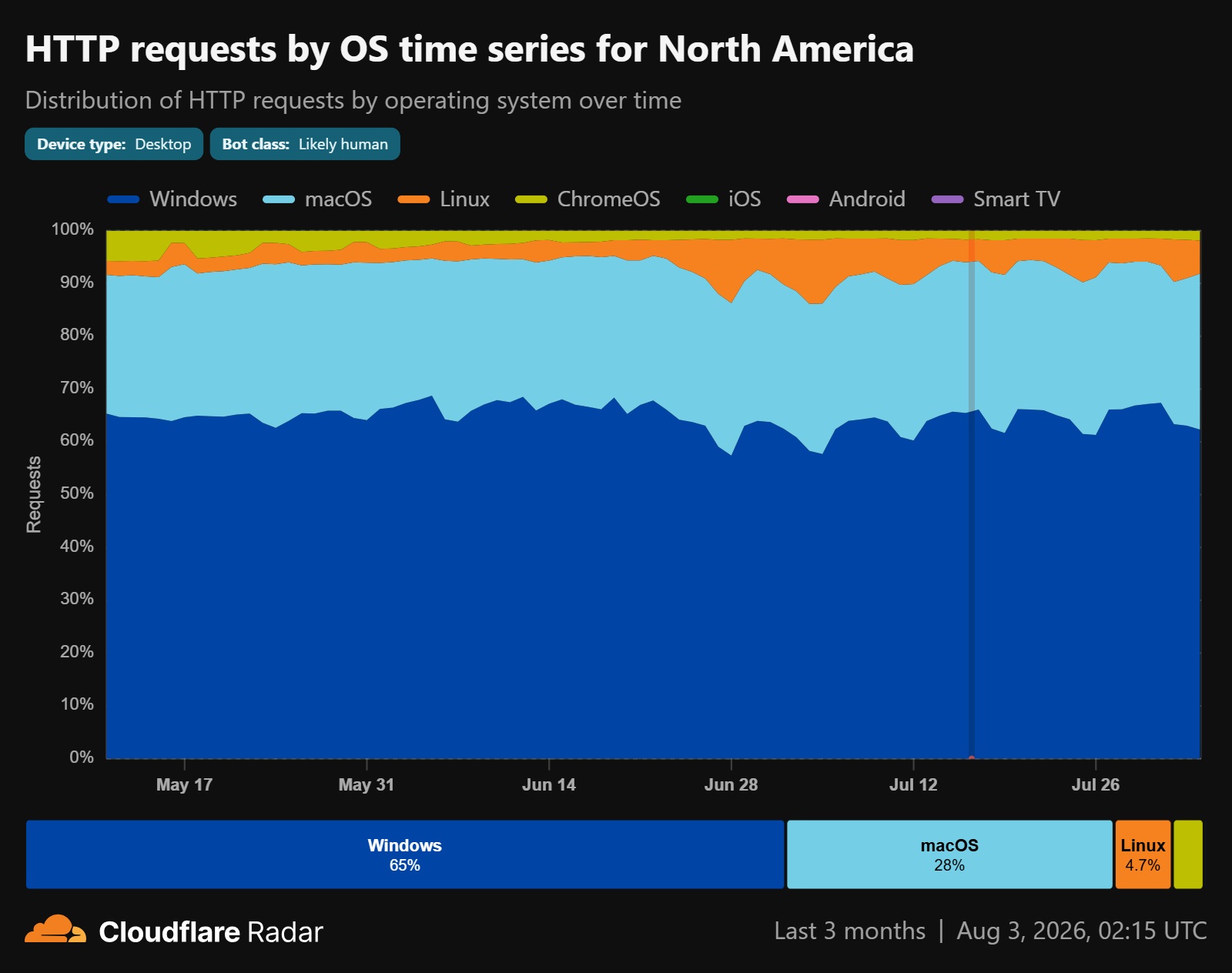
Linux now sits at roughly 4.7% over the last three months for human-only traffic, while Windows holds around 65% and macOS around 28%.
The moment you turn off the human-only toggle, automated traffic is included, and Linux jumps to 16% on average, spiking as high as 26% on individual days, while Windows drops to the mid-50s from its usual 65% share of human traffic.
Within automated traffic, Linux and Windows move as near-perfect mirror images of each other, as their daily shares correlate at about -0.91. When bot-driven Linux goes up, bot-attributed Windows goes down by almost the same amount, while macOS barely twitches.
I don’t think most people understand that Linux is a choice consumers need to make. It’s not preinstalled on most PCs, and those who build their own PCs usually do so for gaming and prefer Windows over Linux for obvious reasons. It’s also the same reason why Android forks do not have a noticeable market share. You need to install them.
Linux is a great platform, but we need to stop believing these viral numbers
I’m also not writing this simply because the website is called Windows Latest. I use Windows and prefer it for my own reasons, but I also rely on Linux for specific workloads, including running this website’s server. Linux is an incredible operating system, and Microsoft itself supports it with its own Linux distro while contributing heavily to open-source software.
However, we don’t have to back false claims to support our favorite product. Now is the time to stop believing these numbers, as they’re often misleading and not really meant for market share analysis. If anything, we’re seeing a collapse in human traffic and a rise in bots, which is worse than the ‘Windows vs Linux vs macOS’ fan wars.