








I’ve written previously about the supposed realization in Microsoft that they need to pay more attention to Windows 11. To illustrate how Windows’ importance within the company has been overtaken, let’s look at some financial data.
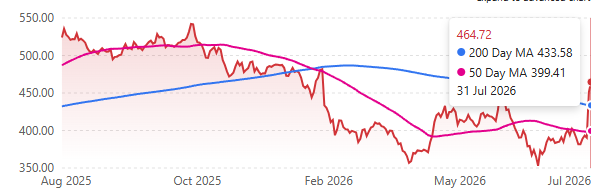
Microsoft published their latest fiscal year results, for the year ending June 2026. The numbers look very good if you’re a shareholder or investor – they beat estimates across the board, leading to a 16% rise in MSFT’s share price in one day, the largest ever one-day rise in stock market history (adding nearly half a trillion dollars to their market value). It was still $100 short of the peak in October 2025, when investors got spooked at Q1 FY26 fiscal results, the increasing capital expenditure on datacenters and slower uptake in Copilot usage.
Microsoft has historically been vague at admitting where revenue is really coming in and how the cash is being spent with respect to individual products. Instead, they lump things together into categories like “Intelligent Cloud” (Azure, Github, servers – including Windows Server, and enterprise services). Windows client falls under “More Personal Computing”, which includes Surface devices and accessories, Xbox consoles and games/services and Bing/MSN advertising. These categories don’t exactly correspond to the corporate structure, i.e. there isn’t a “More Personal Computing” business unit per se, they’re just a convenient way for doing the financial reporting over the last few years.
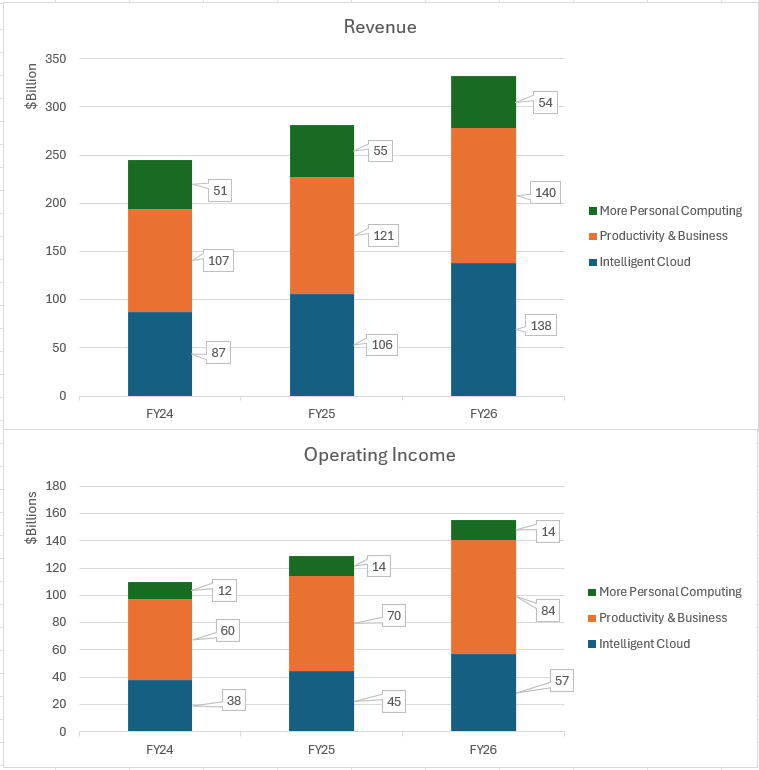
It’s clear to see that “Productivity & Business” (which, alongside LinkedIn and Dynamics 365 includes Microsoft 365 services, apart from the revenue from Windows client licenses which are bundled in M365 but accounted for under More Personal Computing) is hugely successful, delivering the biggest slug of revenue and the highest profit.
For the last decade or more, Azure gets much of the attention inside Microsoft, and it makes up the biggest part of the Intelligent Cloud number; while it’s not broken out explicitly, Microsoft did say that Azure crossed the threshold of $100Bn in revenue this FY, meaning it’s the largest single product category in the company.
In FY26, More Personal Computing (MPC) delivered $54Bn in revenue, with an operating income of $14.4Bn. The revenue is down around $600M from the previous year but operating income is up $220M, so savings were being made somewhere or the mix of product was that higher-margin stuff was selling more.

Some analysts reckon Windows margin is 80%+, but if that $54Bn revenue is coming out at “only” $14.4Bn in income, the margin for everything that makes up MPC is more like 27%. That’s probably a lot of Surface hardware, Xbox Game Pass operating costs and a load more.
Commercial analysts have estimated that Windows client revenue accounts for a little more than 5% of Microsoft’s overall revenue; so for FY26 that might mean $17Bn in revenue and something like $10Bn of income. Still not too shabby.
But when you put the Windows revenue in context with everything else, it’s no wonder that Microsoft’s attention might have strayed from investing in what is a pretty stable and mature market, unless you consider ramming Copilot and other stuff in as “product improvement”.
If we make some estimates about the relative size of Windows within More Personal Computing and split them out, it’s clear that Windows is the largest part of that category’s profit, even if revenue from other parts of MPC is higher.
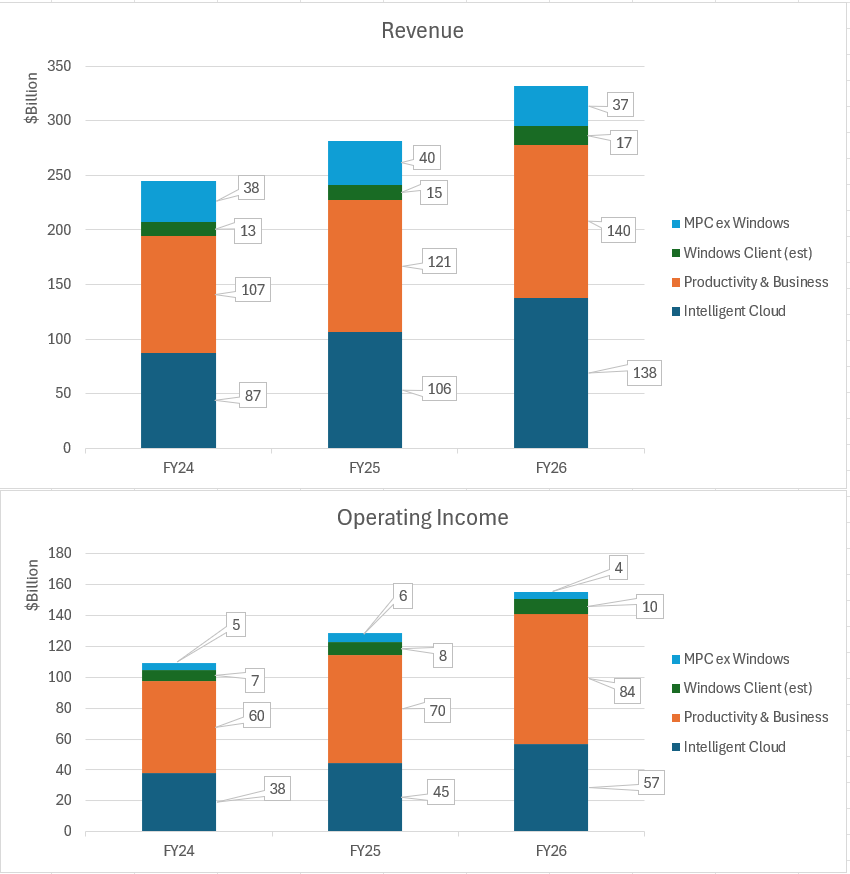
The total operating income from Windows is a drop in the ocean compared to everything else – Azure, even with all its datacenter capital expenditure and operating cost, probably brings in 4x the profit of Windows Client. LinkedIn on its own probably accounts for about $6Bn or $7Bn of income (and brought in nearly $20Bn in revenue).
If the Windows development team can focus more on quality, removing the unpopular advertising and unwanted AI stuff that’s been pushed in over the last couple of years, it may carry on being a multi-billion dollar profit center. It could even grow at double-digit %ages, which would be a dream scenario for many mature businesses. But it’s not going to be growing at 40% year on year, as Azure has been.
Any investment that Microsoft puts into making Windows 11 better must be seen as keeping existing users happy so they will continue to buy all the other stuff. As fans of Windows, we can only hope that it continues.